AgentOps
AgentOps is a developer platform for monitoring, debugging, and optimizing AI agent applications in production Pricing: Freemium (Free for up to 10K events/month; paid plans from $49/month). See pros,
- Open Source
- Web, API
- WritingDeveloper ToolsCode
- Open source
- Free forever
What is AgentOps?
Key features
Event logging
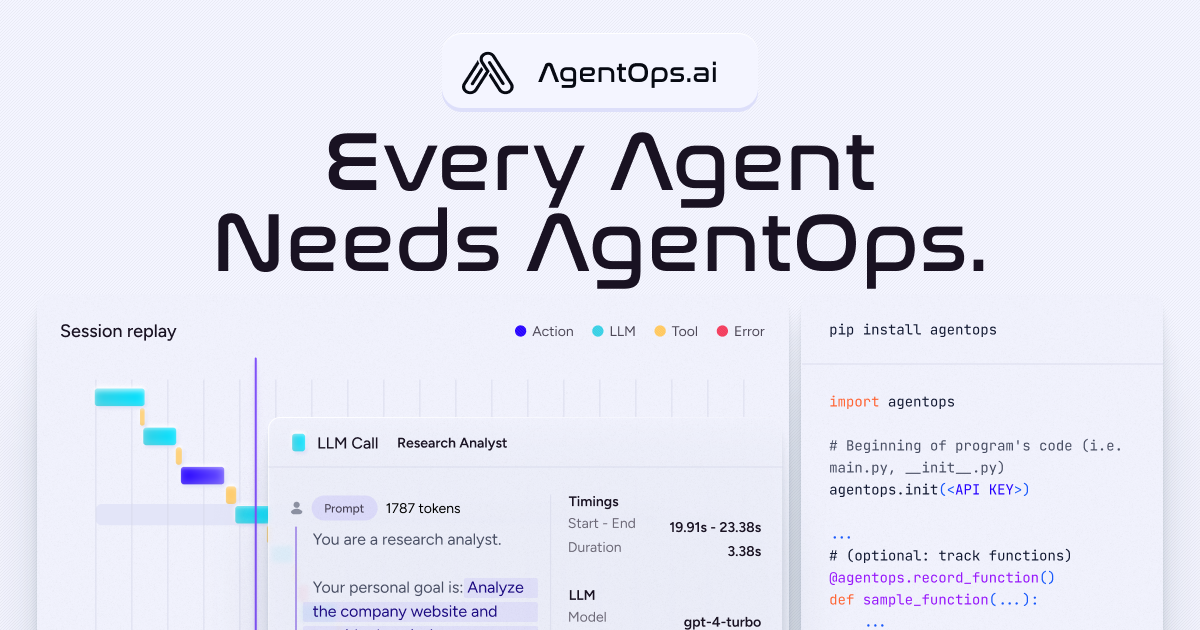
Captures detailed records of agent actions, decisions, and API calls during execution
Session recording
Tracks complete agent sessions so you can replay and analyse what happened
Performance metrics
Shows execution time, token usage, cost, and other operational data
Debugging tools
Helps identify where agents fail or behave unexpectedly
Integration support
Works with common AI frameworks and agent libraries via SDKs
Pros & cons
Advantages
- Free tier covers small-scale development and testing with 10K events per month
- Purpose-built for AI agents rather than generic application monitoring
- Straightforward integration through SDKs for popular frameworks
- Transparent pricing starting at $49/month for production use
Limitations
- Requires code changes to integrate the SDK into your agent application
- Free tier has limited event capacity, so high-volume agents will need paid plans quickly
- Primarily focused on monitoring and debugging rather than agent optimisation or tuning
Use cases
Debugging autonomous agents that behave unexpectedly in production
Tracking costs and token usage for LLM-based agent applications
Analysing agent decision-making patterns to improve reliability
Monitoring multi-agent systems to understand inter-agent interactions
Identifying performance bottlenecks in agent workflows
Ready to try AgentOps?
Pricing
Get started with AgentOps
Click through to AgentOps and start using it now.
- Open source
- Free forever