
Albumentations
Efficiently enhance and manipulate images with seamless integration to popular deep learning frameworks.
- Freemium
- Python (via pip/conda installation)
- AI Tools for PythonImage GenerationDeveloper Tools
- Free plan available
- No credit card
What is Albumentations?
Key features
Wide range of image transformations
rotation, flipping, brightness/contrast adjustments, geometric distortions, and more
Framework integration
works smoothly with PyTorch, TensorFlow, Keras, and other deep learning libraries
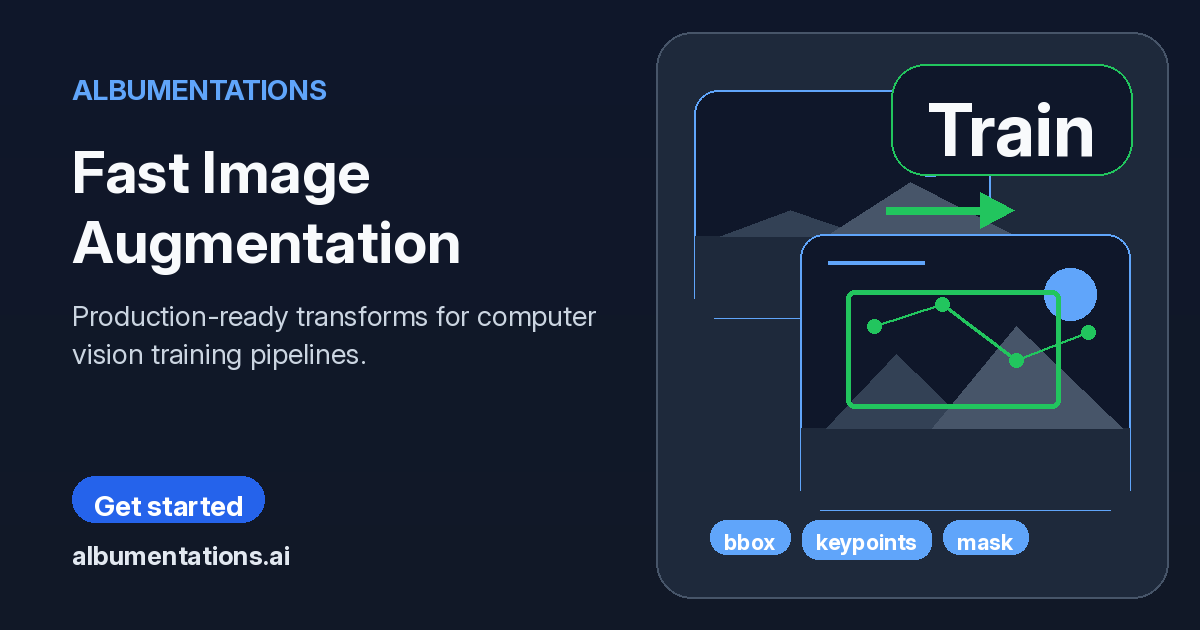
Bounding box and keypoint support
augments labels alongside images for object detection and pose estimation tasks
Composition and chaining
combine multiple transformations in flexible pipelines
Efficient performance
optimised for speed during training loops
Probability-based application
control whether and how often each transformation is applied
Pros & cons
Advantages
- Easy to integrate into existing training pipelines with minimal code changes
- Handles both images and associated labels (boxes, keypoints, masks) correctly
- Good documentation and active community support
- Free and open source with no proprietary restrictions
Limitations
- Primarily a Python library, so limited use outside Python-based workflows
- Requires basic programming knowledge to set up and configure augmentation pipelines
- Can be overkill for simple projects that need only basic image transformations
Use cases
Augmenting training datasets for image classification models when data is scarce
Preparing data for object detection models that need to recognise objects at various angles and scales
Improving model generalisation for medical imaging or satellite imagery analysis
Data augmentation in keypoint detection for pose estimation tasks
Ready to try Albumentations?
Pricing
Free
Free
Full access to all augmentation transformations, framework integrations, and community support
Get started with Albumentations
Click through to Albumentations and start using it now.
- Free plan available
- No credit card