
Apache TVM
Open-source ML compiler framework for diverse hardware.
- Free
- API, macOS, Windows
- DesignDeveloper ToolsCode
- Always free
- No credit card
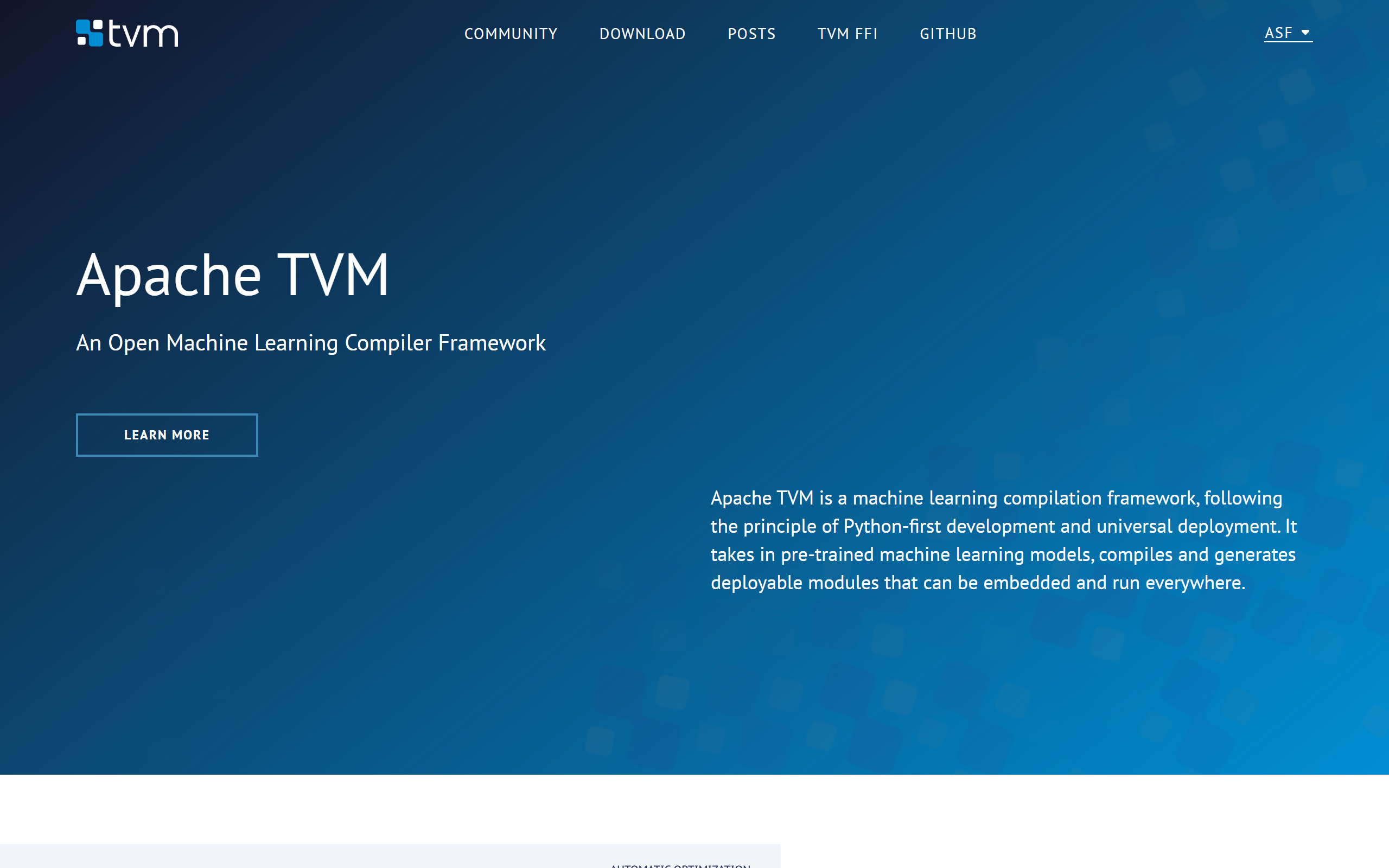
What is Apache TVM?
Key features
Cross-platform compilation
Compile ML models once, deploy to CPUs, GPUs, TPUs, microcontrollers, FPGAs, and web browsers
Multi-framework support
Import models from PyTorch, TensorFlow, Keras, MXNet, ONNX, and other formats
Automatic optimisation
Generates and tunes tensor operators for target hardware without manual kernel writing
Quantisation and sparsity
Built-in support for model compression techniques including block sparsity and quantisation
Multiple language bindings
Use Python for research and prototyping, C++, Rust, or Java for production
Memory optimisation
Includes memory planning and allocation strategies for constrained devices
Pros & cons
Advantages
- Completely free and open-source with no licensing fees
- Supports an exceptionally wide range of hardware targets, from servers to edge devices
- Works with all major deep learning frameworks, reducing model conversion friction
- Active Apache project with ongoing development and community support
- Automatic optimisation reduces manual tuning work compared to writing custom kernels
- Can achieve significant performance improvements over unoptimised deployment
Limitations
- Steep learning curve; requires understanding of compiler concepts and hardware architecture
- Setup and build process can be complex, especially for custom hardware backends
- Community support only; no guaranteed commercial support options
- Some hardware targets require custom tuning to achieve good performance
- Documentation focuses on technical depth rather than beginner walkthroughs
- Compilation times can be lengthy for large models
Use cases
Deploying ML models to mobile phones and tablets where computational resources are limited
Running inference on edge devices like smart home devices, IoT sensors, or industrial equipment
Optimising models for specific hardware accelerators to achieve maximum performance
Creating cross-platform ML services that work consistently across different server architectures
Reducing model size and latency for real-time inference applications
Deploying ML models in web browsers for client-side inference without server calls
Ready to try Apache TVM?
Pricing
Free
Free
Full access to the open-source TVM framework including compiler, runtime, and optimisation tools. Community support via forums and GitHub issues. No licensing restrictions.
Get started with Apache TVM
Click through to Apache TVM and start using it now.
- Always free
- No credit card