
Atomic AI
RNA drug discovery with atomic precision, combining AI foundation models and wet-lab assays to target RNA.
- Paid
- Web
- Data & AnalyticsDesign
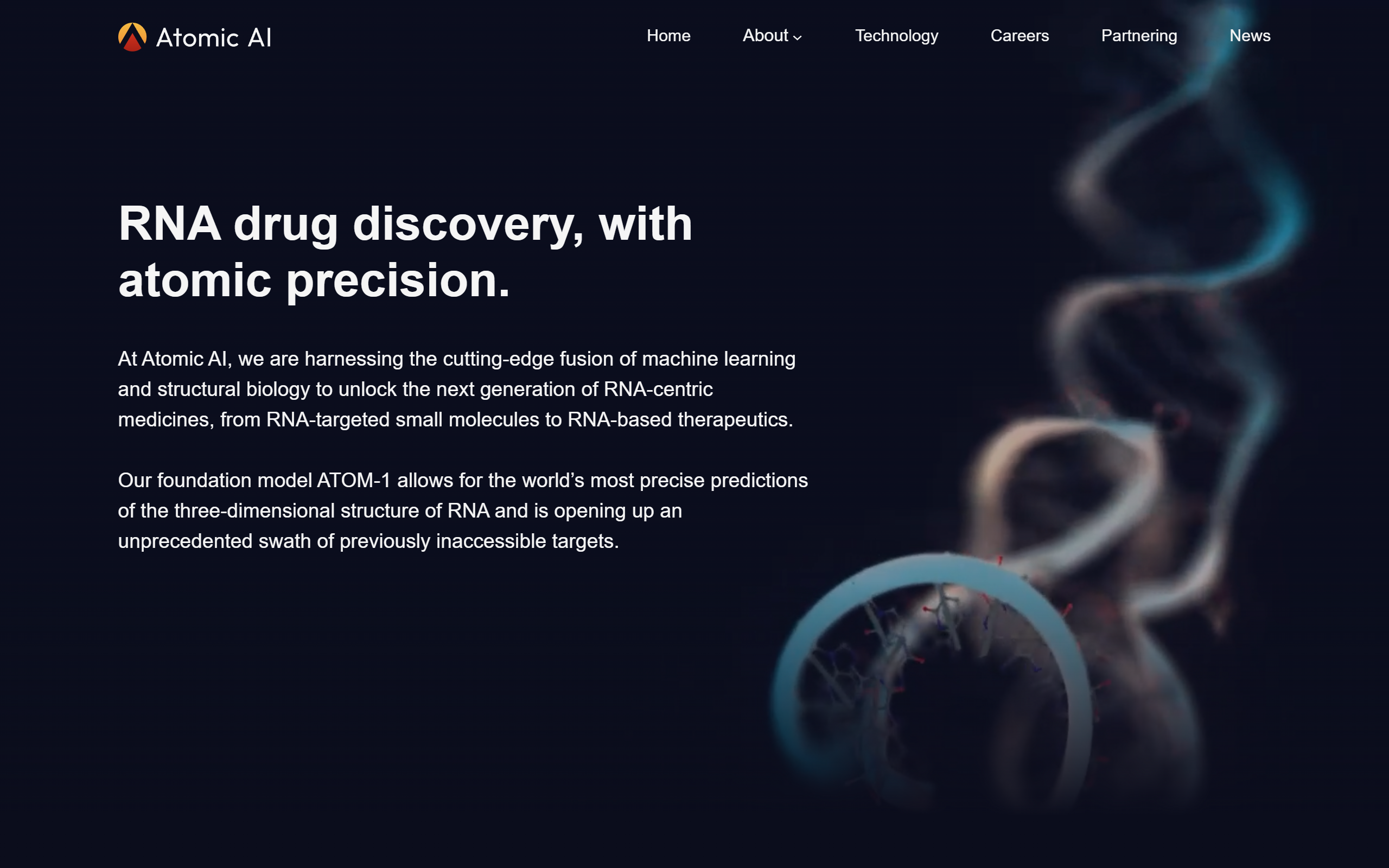
What is Atomic AI?
Key features
ATOM-1 foundation model
A large language model for RNA that predicts three-dimensional RNA structure and functional properties.
PARSE platform
A Platform for AI-driven RNA Structure Exploration that links deep learning models with in-house wet-lab assays.
Chemical mapping data integration
Uses experimental chemical mapping data to train models and optimise molecular design.
RNA-targeted small molecules
Designs selective and potent small molecules that bind difficult RNA targets.
Multi-modality RNA design
Supports RNA-based small molecules, mRNA vaccines, siRNA, and circular RNA therapeutics.
Wet-lab feedback loop
Combines computational predictions with laboratory validation to refine candidate molecules.
Pharma partnering
Offers collaborations that let partner companies apply the platform to their own target areas.
Pros & cons
Advantages
- Built on peer-reviewed research, with geometric deep learning of RNA structure featured in the journal Science.
- Pairs AI predictions with in-house wet-lab assays rather than relying on computation alone.
- Addresses RNA targets that have historically been hard to drug, opening new therapeutic options.
- Backed by an interdisciplinary team and senior scientific advisors from industry and academia.
- Supports multiple RNA modalities, from small molecules to mRNA vaccines and siRNA.
Limitations
- This is a research-stage biotechnology company, not a self-serve software product you can sign up for.
- No public pricing, free trial, or product access is available; engagement is through direct partnering.
- Information on the platform is high level, with limited technical detail published publicly.
- Outputs are therapeutic programmes and partnerships rather than tools for general users.
Use cases
Pharmaceutical companies seeking partners to discover RNA-targeted small molecules in their strategic areas.
Drug discovery teams aiming to pursue RNA targets previously considered undruggable.
Biotech collaborators wanting AI-driven predictions of RNA three-dimensional structure for therapeutic design.
Organisations developing RNA-based modalities such as mRNA vaccines, siRNA, or circular RNA therapeutics.
Research partners looking to combine machine learning models with experimental wet-lab validation.
Ready to try Atomic AI?
Pricing
Partnering
Contact for pricing
Business development collaborations to apply the PARSE platform and ATOM-1 model to a partner's RNA drug discovery programmes. Enquiries handled directly by the team via email (bd@atomic.ai).
Get started with Atomic AI
Click through to Atomic AI and start using it now.