
Charm
Open-source tools and libraries for building glamorous command-line interfaces and terminal applications.
- Open Source
- CLI, Linux, macOS, Windows, Self-hosted, API
- DesignDeveloper ToolsCode
- Open source
- Free forever
What is Charm?
Key features
Bubble Tea
A framework for building terminal user interfaces using the Elm-style model, update and view pattern.
Lip Gloss and Bubbles
A styling and layout toolkit plus a set of reusable components such as text inputs, lists and spinners for terminal apps.
Glow and Glamour
A command-line Markdown reader and a stylesheet-driven Markdown renderer for displaying formatted text in the terminal.
Crush and Mods
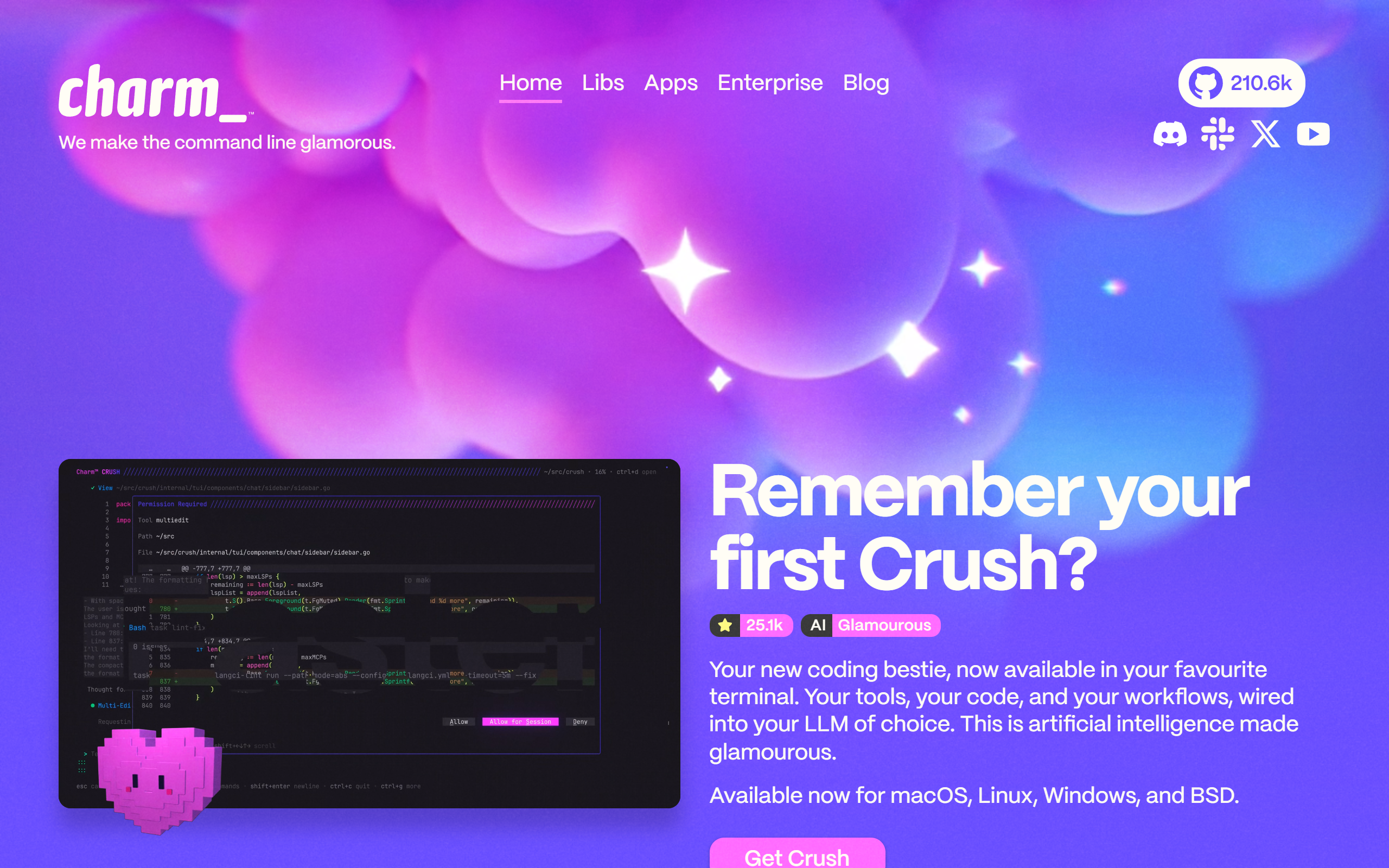
AI on the command line, with Crush an agentic coding assistant and Mods a pipe-friendly interface to LLMs, supporting OpenAI, Anthropic, Azure and local models.
VHS
A tool that records terminal sessions as GIFs from a simple script, useful for documentation and CI-based testing.
Wish and Soft Serve
An SSH application framework and a self-hostable Git server with a built-in TUI and SSH access.
Huh and Gum
A library for building interactive terminal forms and a tool for adding interactive prompts and styling to shell scripts.
Pros & cons
Advantages
- The core libraries and applications are open source under permissive licences, so they are free to use, modify and self-host.
- The ecosystem is broad and consistent, covering TUI frameworks, styling, components, Markdown rendering, SSH apps and AI tooling.
- Tools such as Crush and Mods work with multiple LLM providers, including OpenAI, Anthropic and local models, avoiding lock-in to a single vendor.
- The projects are widely adopted, with the company citing use in more than 25,000 applications, indicating an active community and ongoing maintenance.
- Apps integrate with existing developer workflows through unix pipes, SSH config, CI pipelines and the Model Context Protocol.
Limitations
- The tools are aimed at developers comfortable with the terminal and Go, so they have limited appeal for non-technical users.
- There is no public pricing for the Enterprise offering, so organisations must contact the company to learn costs.
- The previously hosted Charm Cloud service was sunset in late 2024, leaving self-hosting as the path for backend features.
- Documentation and discovery are spread across GitHub repositories rather than a single unified product portal.
Use cases
Developers building interactive terminal user interfaces and dashboards using Bubble Tea, Lip Gloss and Bubbles.
Engineers reading and rendering Markdown directly in the terminal with Glow and Glamour.
Teams adding AI assistance to their command-line workflow through Crush for agentic coding and Mods for piping data to LLMs.
Maintainers recording reproducible terminal GIFs for project documentation and tests with VHS.
Operators running a self-hosted Git server with SSH access and a TUI using Soft Serve.
Script authors making shell scripts interactive with forms, prompts and styling via Huh and Gum.
Ready to try Charm?
Pricing
Open Source
Free
All Charm libraries and applications are free and open source on GitHub, free to use, modify and self-host.
Enterprise
Contact for pricing
Enterprise track for organisations needing dedicated support, integration and custom work; pricing is not published and requires contacting Charm.
Get started with Charm
Click through to Charm and start using it now.
- Open source
- Free forever