
Conversion
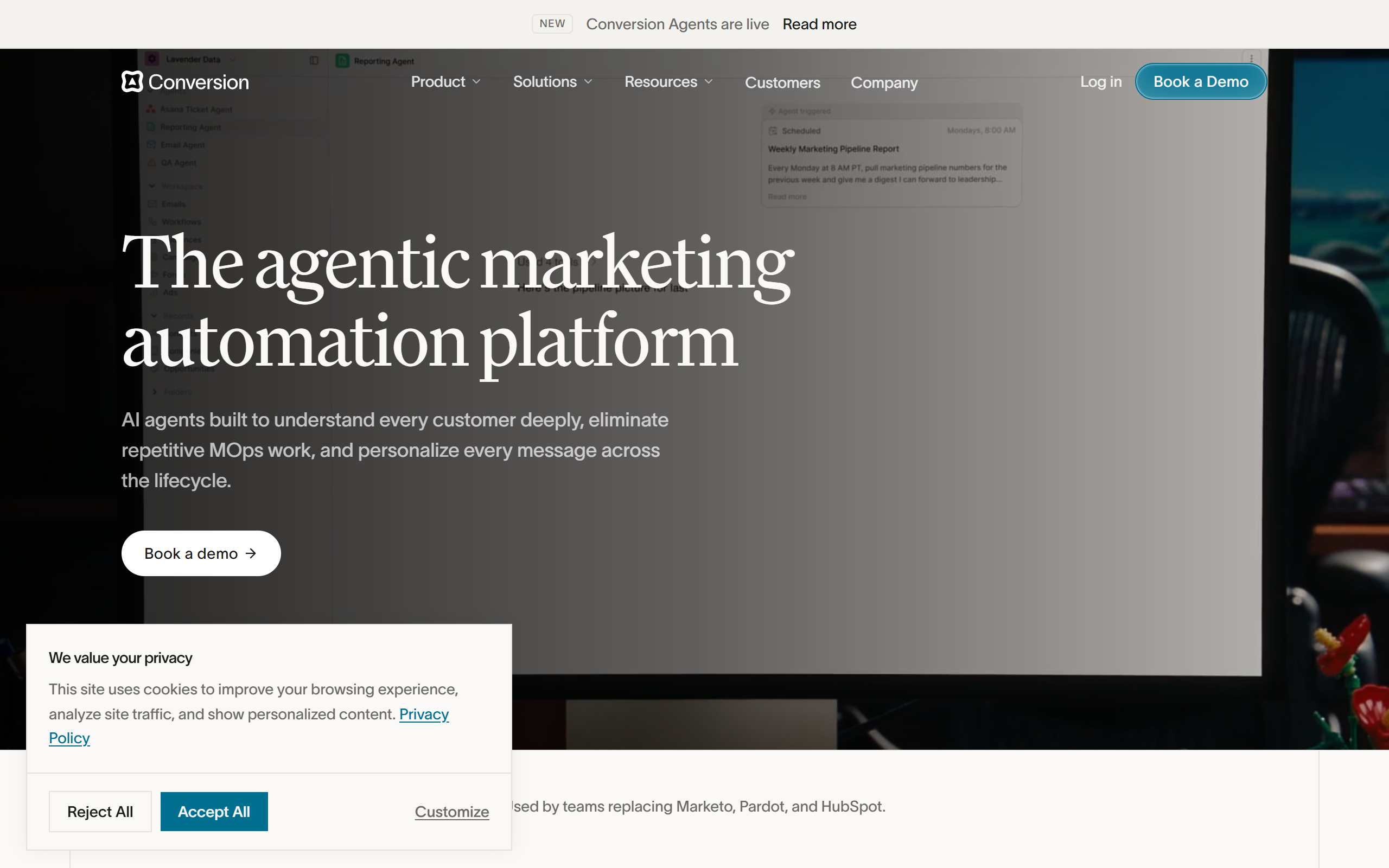
An AI-native B2B marketing automation platform that unifies CRM and warehouse data and runs marketing ops with AI agents.
- Paid
- Web, API
- WritingProductivityMarketing
What is Conversion?
Key features
AI Agents
Autonomous AI teammates that draft campaigns, run QA, route leads and pull reporting, with every action logged and requiring human approval.
Flexible Data Model
Combines CRM and data-warehouse records into one model with two-way Salesforce sync and Snowflake or BigQuery connections.
Email Studio
Drag-and-drop email builder with live personalisation tied to unified customer data.
Real-time Workflows
Visual automation builder that fires on real-time triggers and schedules.
Query Engine and Segmentation
Query-based audience building and real-time segmentation across unified data.
A/B Testing and Reporting
Built-in testing plus campaign reporting tied to pipeline and revenue.
Enterprise Security
SOC 2 Type II, GDPR and CCPA compliance with SSO/SAML, SCIM, role-based access control and audit logs.
Pros & cons
Advantages
- Unifies CRM and data-warehouse records in a single model with two-way Salesforce sync, reducing the need for separate reverse-ETL tooling.
- AI agents handle recurring marketing operations work such as QA, reporting and lead routing while keeping a human-approval step on every run.
- Strong enterprise security and governance posture, including SOC 2 Type II, GDPR, RBAC, SSO/SAML, SCIM and full audit logs.
- Reporting is tied directly to pipeline and revenue, which helps marketing teams connect activity to business outcomes.
- Positioned as a direct replacement for Marketo, Pardot and HubSpot, with published comparison pages for each.
Limitations
- No public pricing is shown, so prospects must book a demo and go through sales to understand cost.
- It is a demo-led enterprise product with no self-serve sign-up, which raises the barrier for smaller teams.
- Deep value depends on Salesforce and a data warehouse such as Snowflake or BigQuery, so teams without that stack may see less benefit.
- As a newer platform replacing established incumbents, it has a thinner public track record of independent reviews.
Use cases
Marketing operations teams replacing Marketo, Pardot or HubSpot with an AI-native automation platform.
B2B marketing leaders who want campaign reporting tied to pipeline and revenue rather than vanity metrics.
Teams running lead scoring and routing that needs to react to real-time signals from CRM and product data.
Account-based marketing and lifecycle engagement programmes that depend on unified CRM and warehouse segmentation.
Companies migrating off legacy marketing automation tools who need two-way Salesforce sync and audit-ready governance.
Enterprises that require SOC 2 Type II, SSO/SAML, SCIM and role-based access control for marketing tooling.
Ready to try Conversion?
Pricing
Custom
Contact for pricing
No public pricing. Sold through a book-a-demo sales process; a 7-day free trial is referenced for annual plans. Pricing is tailored to seats, data volume and feature needs.
Get started with Conversion
Click through to Conversion and start using it now.