Deep Learning Book by Ian Goodfellow, Yoshua Bengio, and Aaron Courville
Deep Learning Book by Ian Goodfellow, Yoshua Bengio, and Aaron Courville - AI tool
- Free plan available
- No credit card
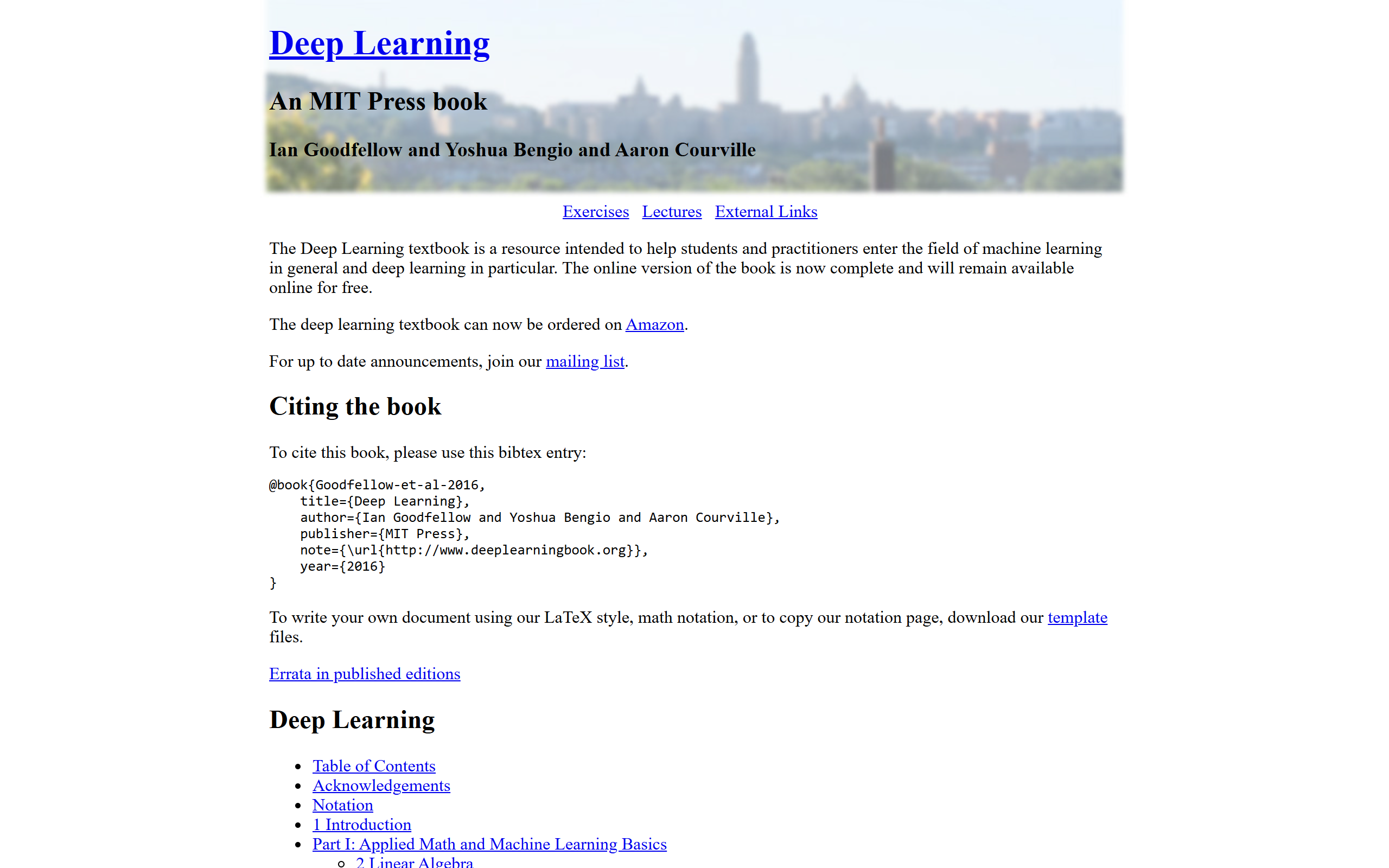
What is Deep Learning Book by Ian Goodfellow, Yoshua Bengio, and Aaron Courville?
Key features
Complete online textbook covering deep learning theory and practice
Mathematical explanations of core concepts including backpropagation, optimisation, and regularisation
Coverage of architectures like convolutional networks, recurrent networks, and autoencoders
Chapters on practical applications and deployment considerations
Free access to all content with optional downloadable PDF version
Figures and equations to illustrate key concepts
Pros & cons
Advantages
- Completely free and accessible online
- Written by leading researchers in the field with years of industry experience
- Balances theory with practical understanding rather than just recipes
- Covers both foundational concepts and advanced topics in one place
- Well-structured progression from basics to complex material
Limitations
- Dense mathematical content requires strong background in calculus, linear algebra, and probability
- Not interactive; no code examples or hands-on exercises built into the book itself
- Can be slow reading for those new to machine learning; better as a reference than introduction
Use cases
Students learning the theoretical foundations of neural networks and deep learning
Researchers understanding the mathematical principles behind published algorithms
Practitioners filling gaps in their knowledge of how deep learning models actually work
Academic courses using a standard reference text for machine learning curricula
Engineers moving from applied deep learning to research-focused roles
Ready to try Deep Learning Book by Ian Goodfellow, Yoshua Bengio, and Aaron Courville?
Pricing
Get started with Deep Learning Book by Ian Goodfellow, Yoshua Bengio, and Aaron Courville
Click through to Deep Learning Book by Ian Goodfellow, Yoshua Bengio, and Aaron Courville and start using it now.
- Free plan available
- No credit card