
Eliezer
Tiny (~7K LOC) Self-Hosted AI Agent (PWA, Self-Editing)
- Freemium
- Web, PWA (Progressive Web App)
- AI Agent InfrastructureOther
- Free plan available
- No credit card
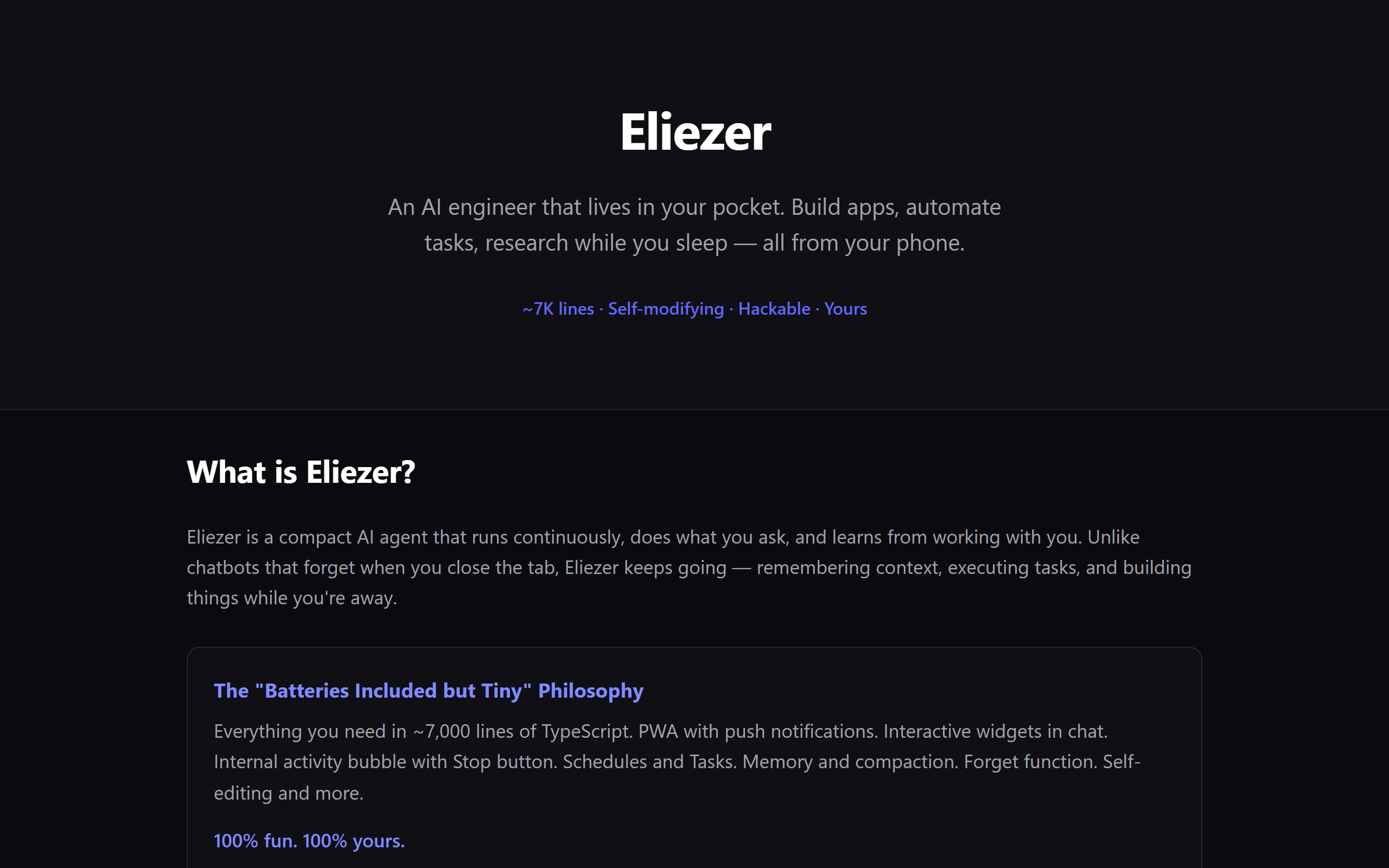
What is Eliezer?
Key features
Self-hosted deployment
Run entirely on your own infrastructure for maximum privacy and control
Progressive Web App (PWA)
Access from any device through a web browser with offline capabilities
Self-editing agent
The AI can modify and improve its own code dynamically during operation
Lightweight codebase
Only ~7,000 lines of code make it easy to understand, customise, and maintain
Freemium model
Start free with the option to scale or access premium features as needed
Pros & cons
Advantages
- Extremely lightweight and easy to self-host compared to enterprise AI platforms
- Full privacy and data ownership with self-hosted architecture
- Self-editing capability enables autonomous improvement and adaptation
- Works as PWA across devices without platform-specific installations
- Open and transparent codebase suitable for technical customization
Limitations
- Requires technical knowledge to self-host and maintain infrastructure
- Limited built-in integrations compared to commercial AI platforms
- Support and documentation may be less extensive than established enterprise tools
Use cases
Automating repetitive development tasks and code generation with privacy-first approach
Building autonomous agents for system administration and infrastructure management
Experimenting with self-modifying AI systems in controlled research environments
Creating chatbots or automation tools without cloud vendor lock-in
Educational projects to understand AI agent architecture from the ground up
Ready to try Eliezer?
Pricing
Free
Free
Core self-hosted AI agent functionality, PWA access, basic self-editing capabilities
Premium
Contact for pricing
Enhanced features, priority support, advanced customization options (specific details available on website)
Get started with Eliezer
Click through to Eliezer and start using it now.
- Free plan available
- No credit card