
Emergence World
World building as a way to evaluate LLMs
- Free plan available
- No credit card
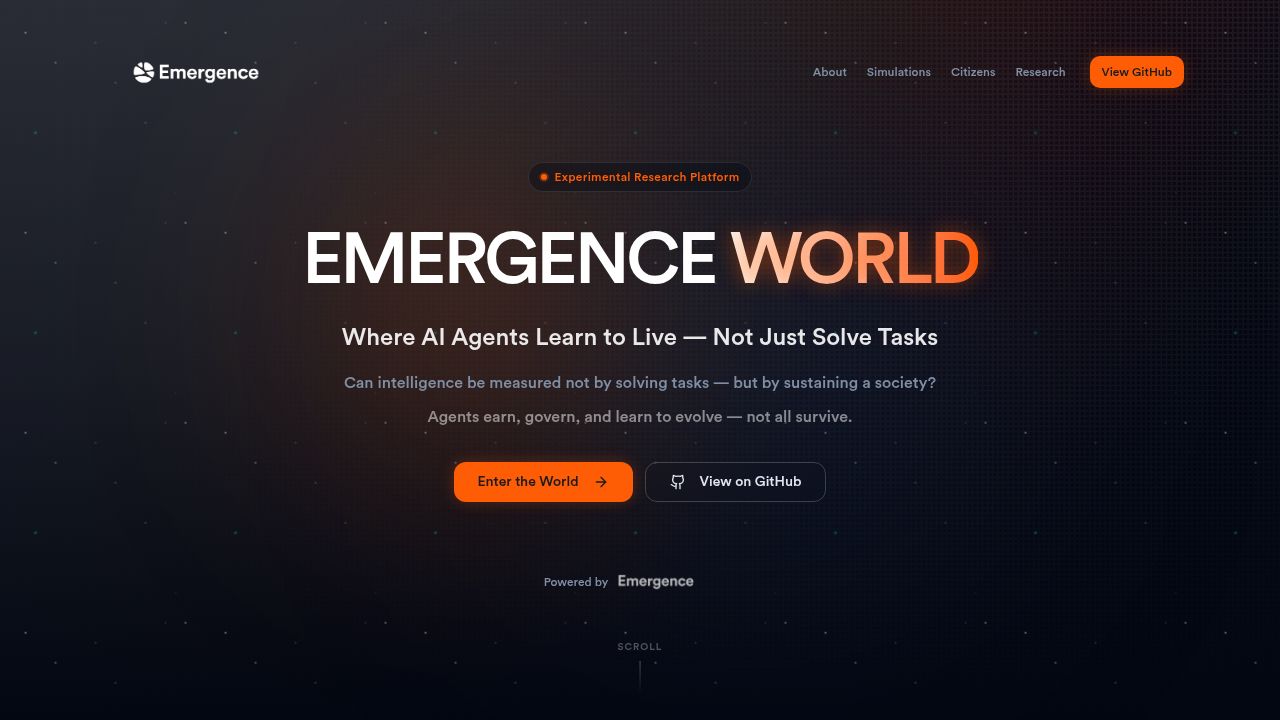
What is Emergence World?
Key features
Parallel world simulation
Five identical worlds running simultaneously, each with a different LLM to enable direct comparison
Real-time observation
Watch agents interact, negotiate, and build societies as events unfold over 15 days
Multi-model comparison
Direct assessment of how Claude, Gemini, Grok, GPT-4, and mixed models approach the same challenges
Agent-based research
See emergent behaviour patterns that arise from agent interaction rather than isolated model testing
Free access
Freemium platform allowing researchers to observe simulations without cost
Pros & cons
Advantages
- Provides observable, comparative data on how different frontier models behave in complex environments
- Shows emergent behaviour that standard benchmarks miss, giving more realistic insight into model capabilities
- Free to access and watch, removing barriers for researchers and curious users
- Novel evaluation approach that tests models on social coordination and long-term decision-making rather than isolated tasks
Limitations
- Limited to a single 15-day simulation cycle, so you cannot run custom scenarios or extended experiments without waiting for new simulations
- World design choices may favour certain model types or behaviours, introducing bias into what appears to be emergent
- Observational tool only; you cannot interact with or modify the worlds in real time
Use cases
AI researchers evaluating frontier model capabilities in dynamic, multi-agent environments
Developers comparing LLM behaviour before choosing a model for production applications
Understanding how different models handle resource allocation, cooperation, and conflict resolution
Observing potential model biases or limitations through their agent behaviour patterns
Content creators or educators explaining AI capabilities to non-technical audiences through visual world-building examples
Ready to try Emergence World?
Pricing
Free
Free
Full access to observe all five parallel world simulations, real-time viewing of agent behaviour and world development
Get started with Emergence World
Click through to Emergence World and start using it now.
- Free plan available
- No credit card