Exa
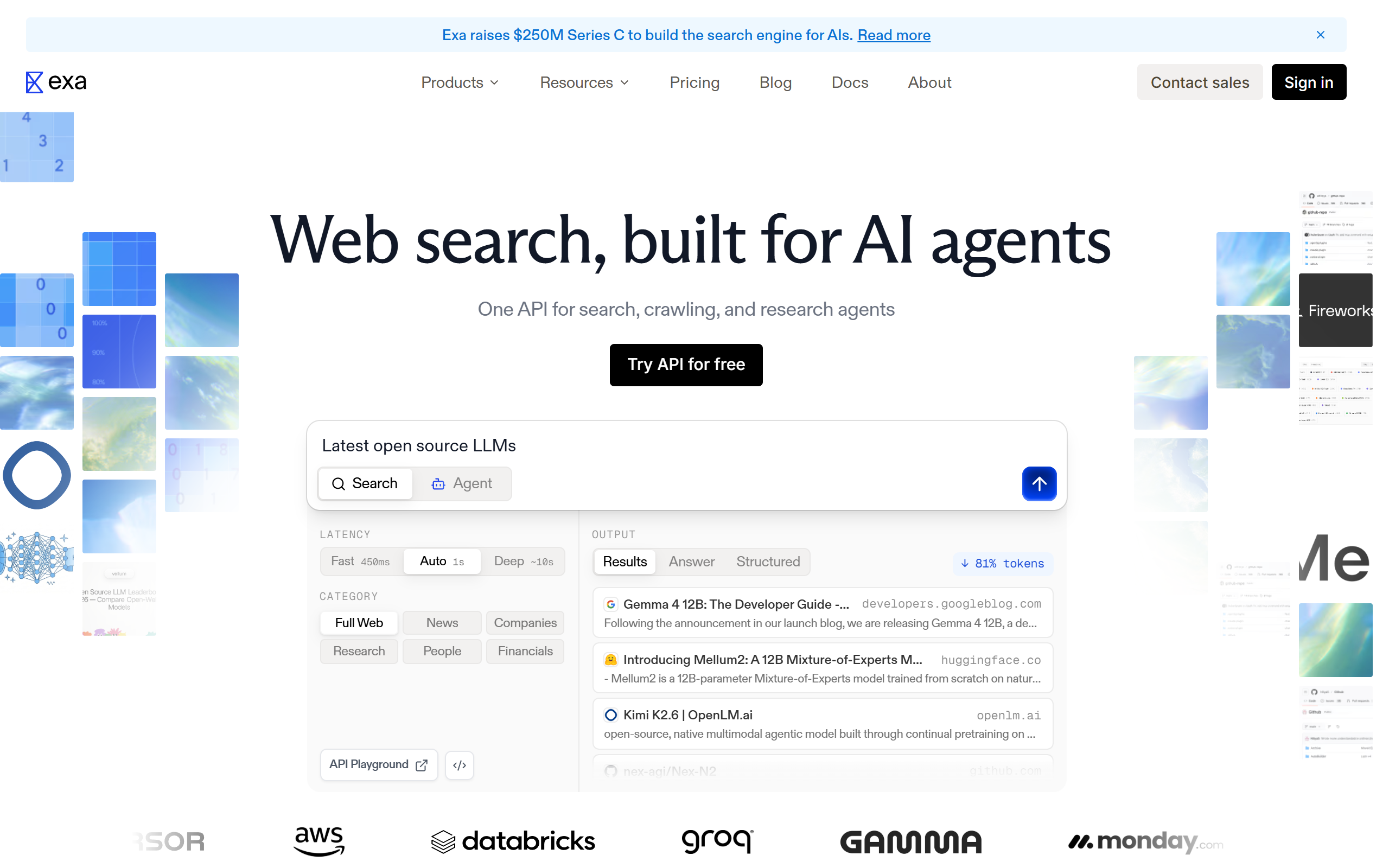
Web search API built for AI agents, with fast search, full page contents, structured outputs and deep research.
- Freemium
- Web, API
- ResearchDeveloper ToolsCode
- Free plan available
- No credit card
What is Exa?
Key features
Search API
Web search tool calls for agents with configurable latency from roughly 180ms to 1 second, returning relevant URLs and metadata.
Contents extraction
Returns full page text and token-efficient AI highlights that can cut token usage by up to 90 percent for LLM context.
Structured outputs
Returns results in customisable JSON schemas, with coverage cited at over 70 million companies and category filters for news, companies, research, people and financials.
Deep and Deep-Reasoning Search
Multi-step agent workflows that produce answers with web-grounded citations and structured outputs.
Agent runs
Asynchronous research runs with selectable effort modes (low to x-high) that return structured outputs with citations.
Monitors
Scheduled search runs that identify fresh events on the web and push webhook updates.
Enterprise security
SOC 2 Type II certification, Zero Data Retention options, Single Sign-On and custom rate limits.
Pros & cons
Advantages
- Pricing is transparent and usage based, with a free tier of up to 1,000 requests per month so developers can test before paying.
- A single API covers search, content extraction, structured outputs and deeper research, reducing the need to stitch together multiple services.
- Token-efficient highlights help keep LLM context costs down, which matters for high-volume agent workloads.
- It is purpose-built for AI agents and cites strong results on retrieval benchmarks such as FRAMES, Tip-of-Tongue and Seal0.
- Enterprise options include SOC 2 Type II, Zero Data Retention and SSO for teams with compliance requirements.
Limitations
- The pricing model is granular, with separate charges for search, contents, deep search, monitors and agent runs, which can make total cost hard to predict.
- It is an API-first developer tool, so non-technical users will need engineering help to integrate it.
- Higher-volume needs, custom datasets and SLAs require contacting sales for custom Enterprise pricing.
- Deep and agent modes add latency (deep search around 10 seconds, agent runs longer) compared with the fast search option.
Use cases
Developers building AI agents that need live web search and grounded citations instead of relying on a model's training data.
Teams building RAG pipelines that want full page contents and token-efficient highlights for LLM context.
Companies generating structured datasets of firms, people or financials using Websets and structured JSON outputs.
Researchers and analysts running multi-step deep research queries that return cited, structured answers.
Product teams adding scheduled Monitors to track fresh news or events and trigger webhook notifications.
Enterprises needing search with SOC 2 Type II, Zero Data Retention and SSO for regulated environments.
Ready to try Exa?
Pricing
Free
Free
Up to 1,000 requests per month, web search tool calls for agents, webpage text and highlights, and configurable latency from roughly 180ms to 1 second.
Search
7 per 1,000 requests
Real-time search data, web search tool calls, webpage text and highlights, and configurable latency.
Deep Search
12 to 15 per 1,000 requests
Multi-step agent workflows, answers with structured outputs and web-grounded citations.
Contents
1 per 1,000 pages per content type
Full page contents for LLM context, token-efficient highlights and configurable livecrawl policies. AI page summaries add 1 per 1,000 pages.
Monitors
15 per 1,000 requests
Identify fresh events on the web, scheduled search runs and webhook updates.
Agent
0.025 to 2.00 per run
Asynchronous research runs with fixed effort modes (low 0.025, medium 0.10, high 0.50, x-high 1.00) returning structured outputs with citations.
Enterprise
Contact for pricing
High volume support, custom datasets, enterprise security, custom rate limits, SLAs, 1:1 support and zero data retention.
Get started with Exa
Click through to Exa and start using it now.
- Free plan available
- No credit card