Gitdot
An open-source alternative to GitHub, a home for quality open-source software, built in Rust.
- Freemium
- Web
- Other
- Free plan available
- No credit card
What is Gitdot?
Key features
Rust Git server
A high-performance Git server written in Rust for hosting repositories.
Stacked-diff code review
A review system based on stacked diffs rather than large single pull requests.
Reproducible CI/CD
A continuous integration platform designed to be secure by design, locally testable and reproducible.
Public roadmap and releases
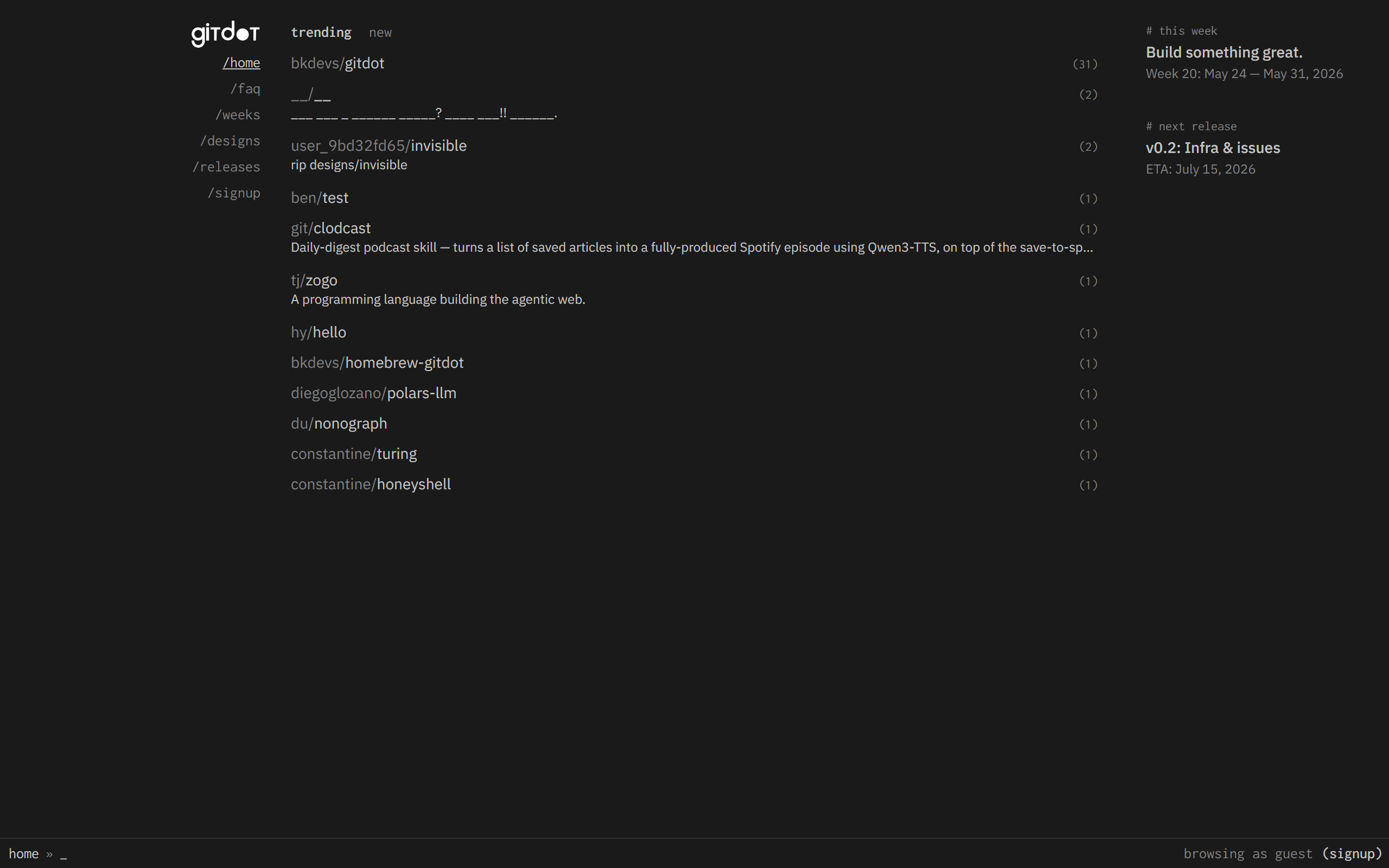
Versioned releases (v0.1 to v0.4) with estimated dates published in the releases section.
Weekly build updates
Regular weekly progress posts documenting development work on the platform.
Design documents
Public technical design write-ups explaining backend and product decisions.
Privacy commitment
A stated policy not to sell or train on user data, with planned end-to-end encrypted Git protocols.
Pros & cons
Advantages
- The platform is open-source under the Apache License, so its code and direction are transparent.
- Development is documented openly through weekly updates, design documents and a versioned release roadmap.
- Public repositories are currently free to host.
- The team commits to not selling user data or training on it, with end-to-end encrypted Git protocols planned.
- It deliberately focuses on code quality and craftsmanship rather than adding AI features.
Limitations
- The product is at a very early stage, with version 0.1 released in June 2026 and core features such as reviews and CI still on the roadmap.
- There is no public pricing page, and paid private team repositories are described only as a future plan.
- Sign-in is currently tied to a GitHub account, which may not suit everyone.
- Many advertised capabilities, including the CI/CD platform and encrypted protocols, are planned rather than available today.
Use cases
Developers who want to host open-source projects on a platform focused on code quality rather than speed.
Teams interested in a stacked-diff code review workflow as an alternative to large pull requests.
Open-source maintainers who prefer a self-funded, Apache-licensed platform that does not train on their data.
Engineers following the project's public roadmap and design documents to evaluate it for future use.
Developers seeking a Git hosting alternative to GitHub that deliberately avoids AI-driven tooling.
Ready to try Gitdot?
Pricing
Public repositories
Free
Hosting for open-source public repositories at no cost during the current early-access period.
Private team repositories
Contact for pricing
Paid private team repositories are planned for the future; no public price has been published yet.
Get started with Gitdot
Click through to Gitdot and start using it now.
- Free plan available
- No credit card