
Hadoop
Process big data efficiently, analyze and store vast amounts of data cost-effectively, with scalability, security, and simplicity.
- Freemium
- Linux, Windows (with workarounds), API (REST and native Java), Cloud (deployable on AWS, Azure, Google Cloud)
- Data & Analytics
- Free plan available
- No credit card
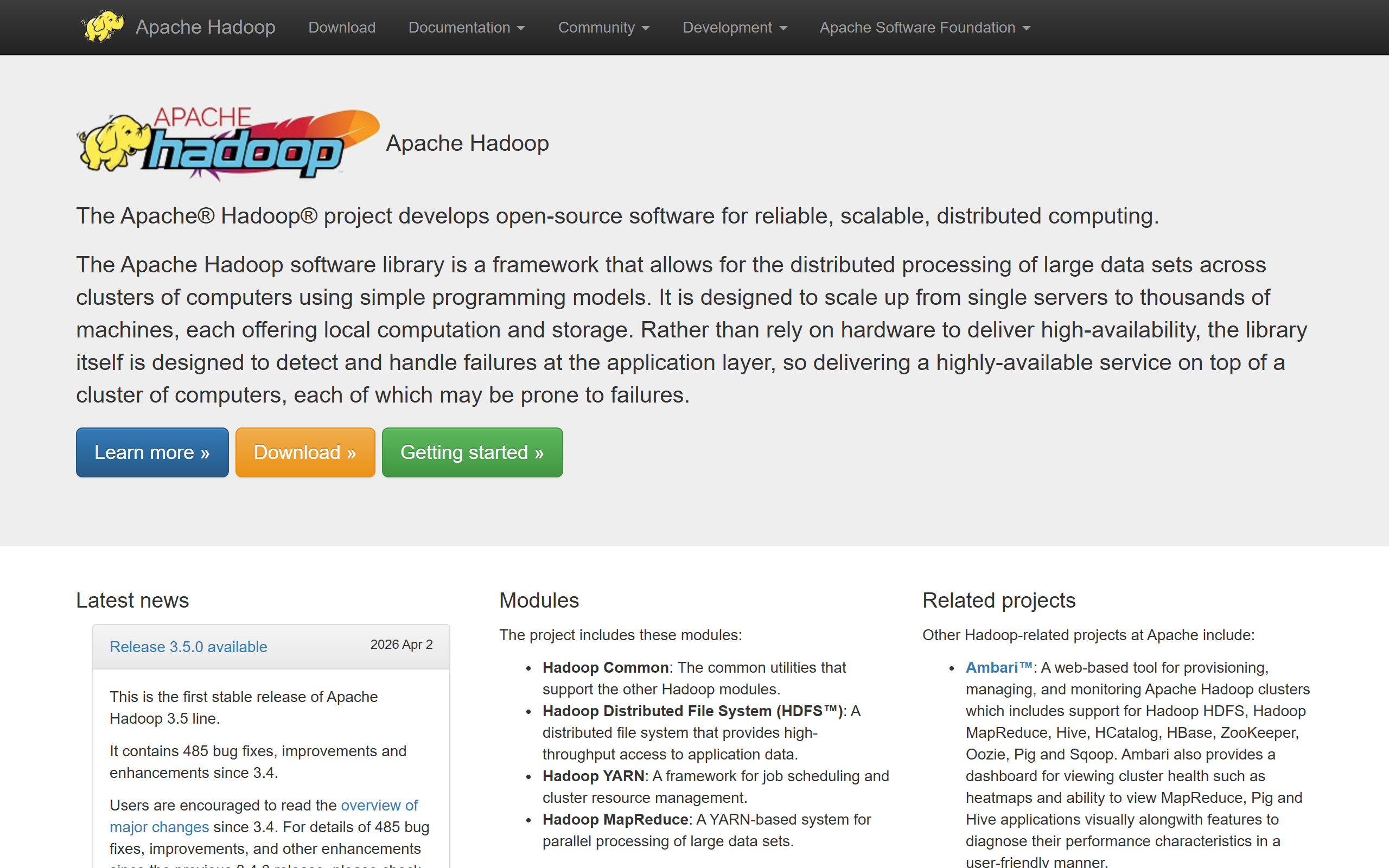
What is Hadoop?
Key features
Distributed file system (HDFS)
stores data across multiple nodes with automatic replication for fault tolerance
MapReduce processing
breaks large computation jobs into smaller tasks that run in parallel across the cluster
YARN resource manager
allocates cluster resources and schedules jobs efficiently
Fault tolerance
automatically recovers from node failures without losing data or interrupting processing
Open source and vendor-neutral
runs on commodity hardware, avoiding vendor lock-in
Scalability
grows from single servers to thousands of machines
Pros & cons
Advantages
- Cost-effective for large-scale data processing; runs on inexpensive commodity hardware
- Highly fault-tolerant; data replication ensures no loss if hardware fails
- Proven at scale by organisations processing petabytes of data daily
- Active open-source community with extensive documentation and tools
- Flexible; works with structured and unstructured data across industries
Limitations
- Steep learning curve; requires understanding of distributed systems concepts and Java programming
- Slower than specialised databases for queries on smaller datasets
- Requires significant operational overhead to maintain and tune clusters
- Not suitable for real-time processing; designed for batch jobs that may take hours
Use cases
Analysing server logs across web infrastructure to identify patterns and issues
Building data warehouses for business analytics on historical transaction data
Preparing large datasets for machine learning model training
Processing unstructured content like images or documents at scale
Running batch ETL jobs to transform raw data into clean, usable formats
Ready to try Hadoop?
Pricing
Commercial Distributions
Varies
Enterprise support, pre-packaged distributions, professional services, commercial tools
Get started with Hadoop
Click through to Hadoop and start using it now.
- Free plan available
- No credit card