Hollow
serverless web perception for AI agents
- Freemium
- Web, API
- AI Tools for Web ScrapingHR & Recruiting
- Free plan available
- No credit card
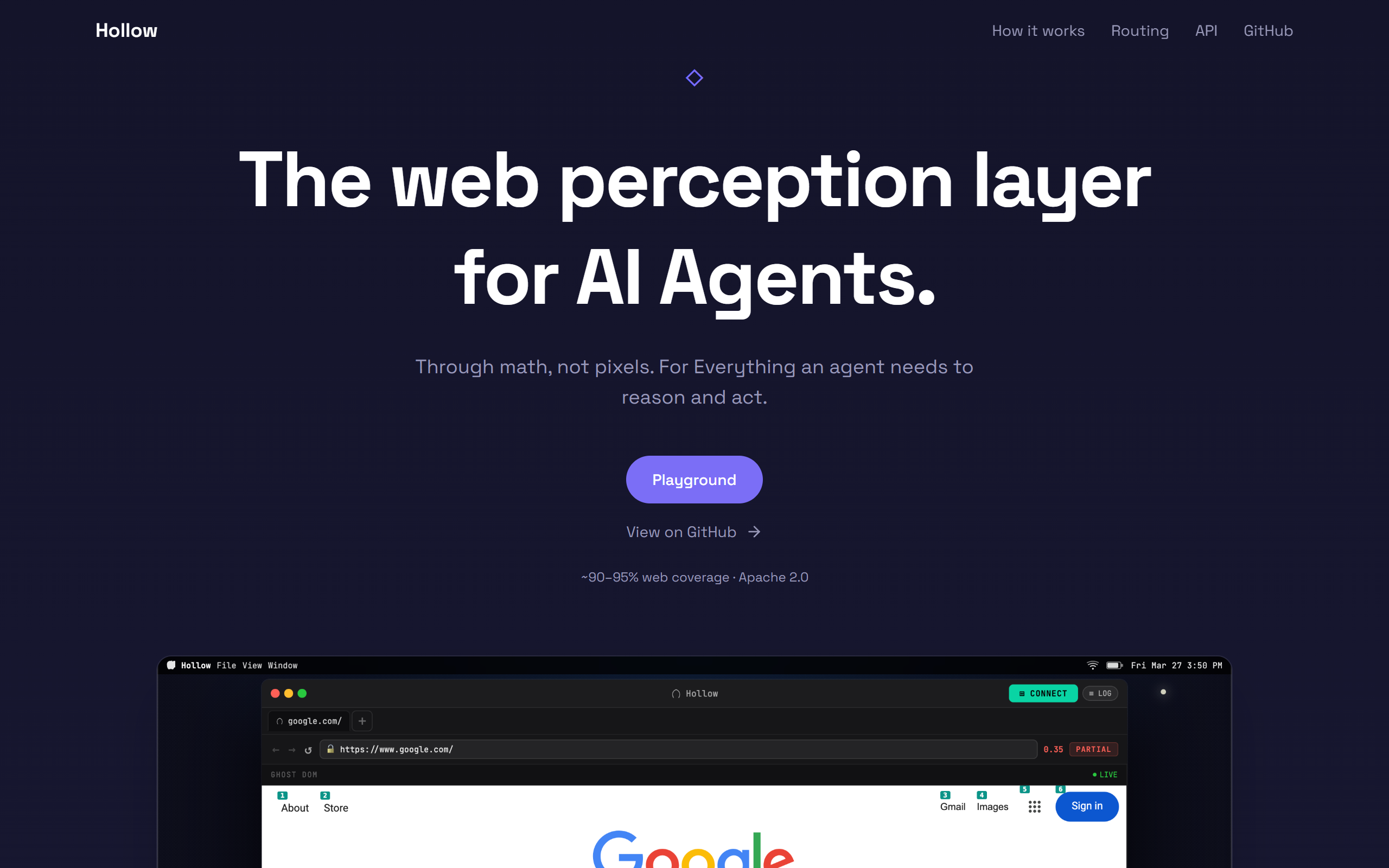
What is Hollow?
Key features
Math-based web perception
Analyses page structure and content through mathematical processing instead of rendering pixels
Serverless compatible
Runs without heavyweight infrastructure, fitting easily into serverless architectures and cloud functions
No Chromium dependency
Eliminates the need for browser automation tools, reducing setup complexity and resource usage
GPU-free operation
Delivers results without specialised hardware, lowering deployment and running costs
Direct data extraction
Pulls structured information from web pages for AI agent consumption
Lightweight integration
Minimal memory and computational footprint suitable for cost-conscious deployments
Pros & cons
Advantages
- Significantly lower resource usage compared to pixel-based or browser-based alternatives
- Faster processing since it analyses structure rather than rendering full pages
- Simpler deployment in serverless and containerised environments
- Reduces infrastructure costs by eliminating GPU requirements and heavy dependencies
Limitations
- May struggle with heavily JavaScript-rendered content that relies on dynamic DOM manipulation
- Limited capability with complex visual layouts where structural analysis alone is insufficient
- Requires web pages to have reasonably well-formed HTML for effective mathematical analysis
Use cases
AI agents that need to extract product information, pricing, or metadata from e-commerce sites
Automated monitoring of website changes or content updates for business intelligence
Web scraping and data collection at scale without heavy infrastructure
Building chatbots or assistants that reference live web content
Content classification and analysis for research or competitive analysis
Ready to try Hollow?
Pricing
Free
Free
Basic access to web perception features; suitable for development, testing, and low-volume use
Paid tier
Pricing not publicly specified
Higher usage limits, priority support, and production-grade service levels for commercial applications
Get started with Hollow
Click through to Hollow and start using it now.
- Free plan available
- No credit card