Legato
a Rust audio graph framework with a minimal DSL
- Free
- API
- DesignDeveloper ToolsAudio
- Always free
- No credit card
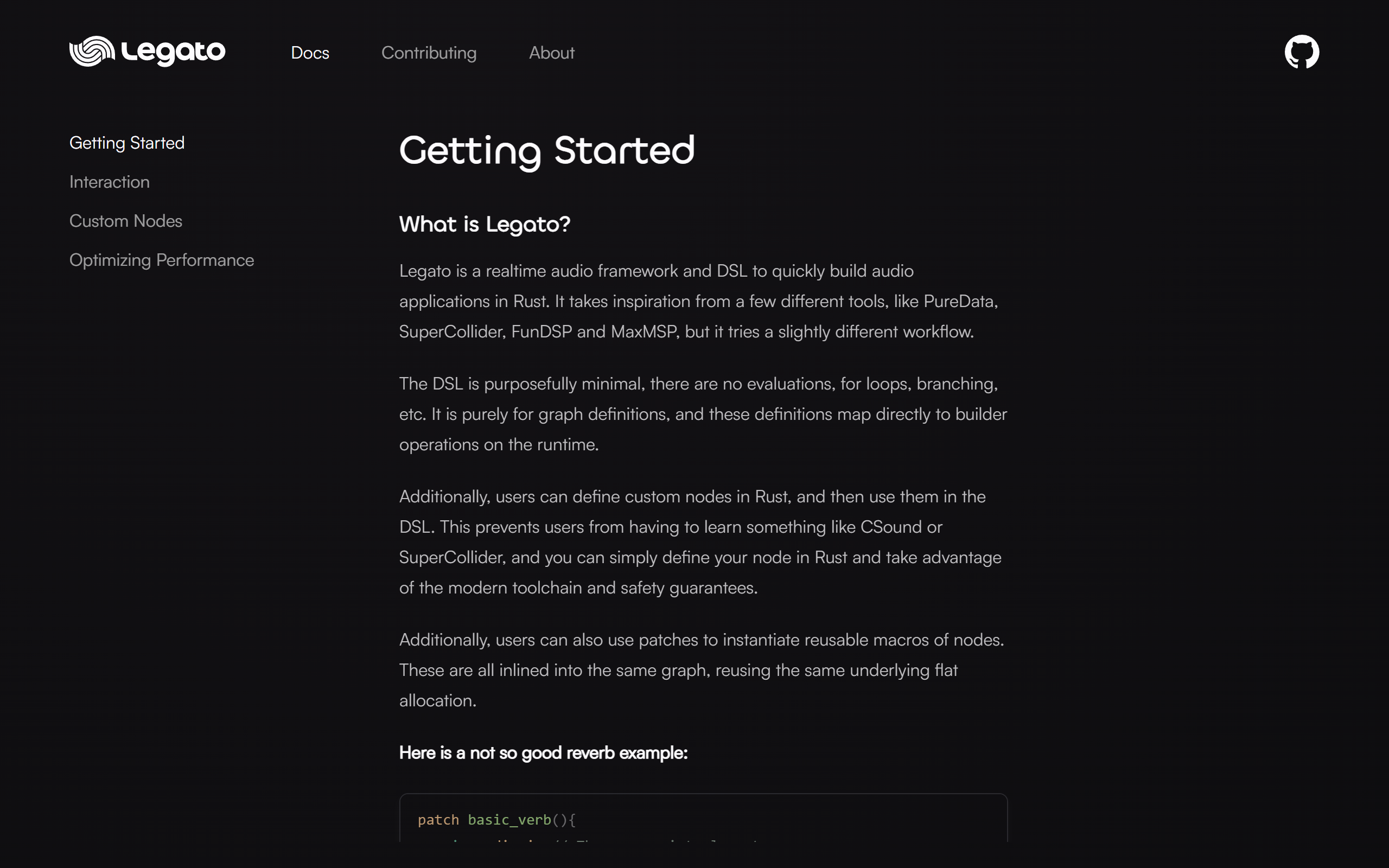
What is Legato?
Key features
Graph-based audio processing
Connect audio nodes to build processing chains and define signal flow
Minimal DSL
Simple syntax for defining audio graphs without verbose boilerplate code
Rust-based framework
Type-safe with strong performance characteristics and memory safety guarantees
Pre-built node library
Common audio primitives like oscillators, filters, and mixers
Pros & cons
Advantages
- Simple DSL reduces development time and makes audio logic easy to understand
- Type-safe Rust prevents many common audio programming errors
- Graph architecture makes signal flow transparent and maintainable
- Good real-time performance suitable for low-latency audio applications
Limitations
- Smaller ecosystem compared to established frameworks like Pure Data or Max/MSP
- Requires Rust knowledge; not accessible to non-programmers or visual-first designers
- Limited VST/AU plugin support compared to industry-standard audio frameworks
- Smaller collection of pre-built nodes and effects compared to mature alternatives
Use cases
Creating custom synthesizers and sound generators
Building audio analysis and processing tools
Prototyping new audio algorithms and digital signal processing
Real-time audio filtering, mixing, and effects applications
Educational projects for learning audio programming in Rust
Ready to try Legato?
Pricing
Free
Free
Full access to Legato framework, all core audio processing features, community support
Get started with Legato
Click through to Legato and start using it now.
- Always free
- No credit card