
MapsGPT
Create a custom interactive map with location pins in seconds using AI prompts.
- Freemium
- Web, Chrome Extension, API
- Data & AnalyticsDesignImage Generation
- Free plan available
- No credit card
What is MapsGPT?
Key features
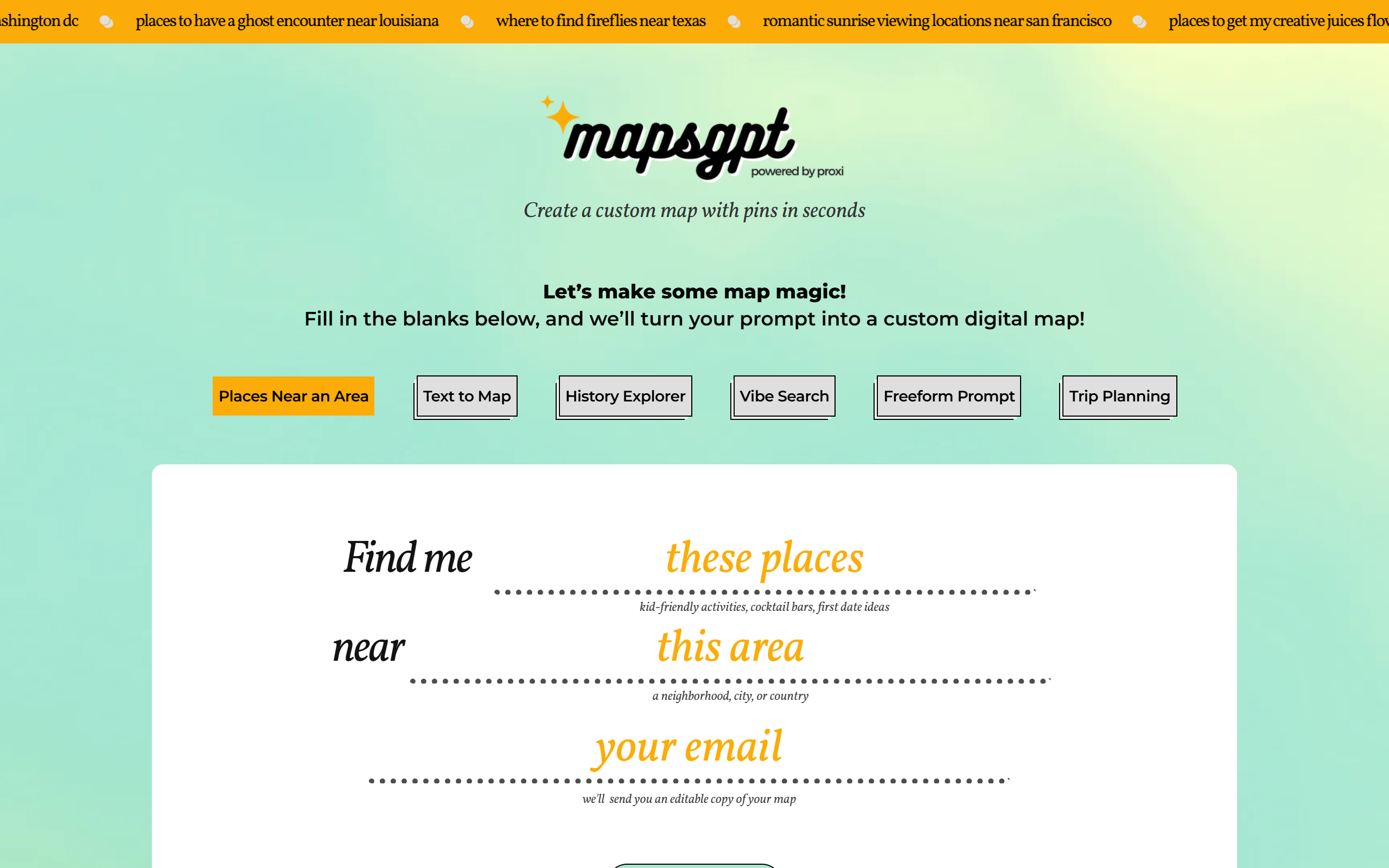
Text to Map
Converts a written description of places into a mapped set of location pins.
Places Near an Area
Finds a specific type of location within a designated region and maps the results.
History Explorer
Identifies and maps historical sites within an area you specify.
Vibe Search
Locates places matching a particular atmosphere, such as artsy, cosy or spooky.
Freeform Prompt
Accepts open ended requests and turns any location idea into a map.
Trip Planning
Generates curated maps for a specific group, event or itinerary.
Editable output
Returns a map you can edit and expand inside the Proxi platform.
Pros & cons
Advantages
- The core map generation is free to try with no upfront payment required.
- Natural language prompts remove the need to manually place pins or learn mapping software.
- Several preset modes cover common needs like trips, history and local discovery.
- Generated maps are editable and connect to the fuller Proxi platform for further customisation.
- It supports related conversion tools including image to map, spreadsheet to map and a URL to map Chrome extension.
Limitations
- The site itself states it cannot guarantee the mapped data is completely accurate or up to date.
- Map output is delivered by email rather than instantly in the browser, adding a step.
- Advanced customisation, branding and analytics require upgrading to a paid Proxi plan.
- Pricing for the paid Proxi tiers is not shown publicly and only appears at self checkout.
Use cases
Travellers building a trip itinerary map of restaurants, sights and stops in a destination.
Local explorers finding cafes, bars or shops that match a particular vibe in their area.
History enthusiasts and educators mapping historical landmarks across a region.
Content creators and bloggers turning a list of places into a shareable interactive map.
Event and community organisers producing a curated map of venues for an audience.
Small businesses creating a local discovery map to highlight nearby points of interest.
Ready to try MapsGPT?
Pricing
MapsGPT Free
Free
Generate custom maps from AI prompts using text to map, vibe search, history explorer, trip planning and freeform modes, with editable output delivered to your email.
Proxi Free
Free
7 day trial of the full Proxi platform to experiment with map building, with clearly marked limits showing what unlocks on upgrade.
Proxi Pro
Contact for pricing
Brandable interactive maps, directory and event calendar tools, AI assisted point adding, 100 SMS and 1,000 emails per month, and up to one million map viewers per month.
Proxi Premium
Contact for pricing
Everything in Pro plus mobile guides, passport events, gated maps, sponsorship management, API access, custom domains, 1,000 SMS and 10,000 emails per month.
Get started with MapsGPT
Click through to MapsGPT and start using it now.
- Free plan available
- No credit card