
Mem0
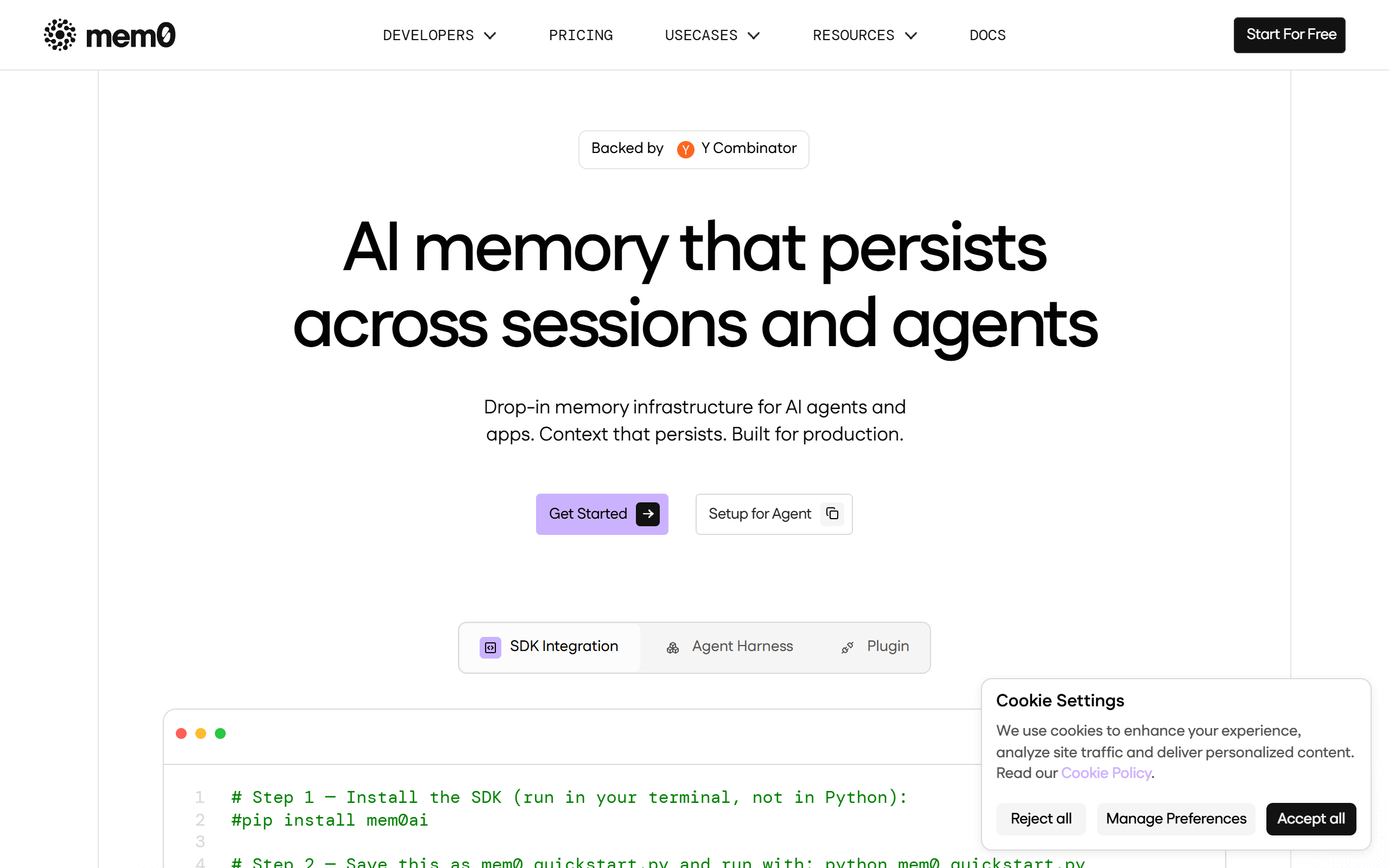
Persistent memory infrastructure that lets AI agents remember user context across sessions and applications.
- Freemium
- Web, API, Python SDK, Node.js SDK, Self-hosted
- Image GenerationDeveloper ToolsCode
- Free plan available
- No credit card
What is Mem0?
Key features
Memory compression engine
Condenses chat histories into compact, contextual memories that can be retrieved on demand.
Add, learn and retrieve workflow
A three-step API for writing memories, extracting facts and recalling relevant context with minimal configuration.
Smart retrieval
Multi-signal retrieval benchmarked on datasets such as LoCoMo, LongMemEval and BEAM.
SDKs and REST API
Official Python (pip install mem0ai) and Node.js SDKs plus a REST API for integration into agent frameworks.
Domain solutions
Pre-built patterns for customer support, healthcare, education, sales and CRM, and e-commerce use cases.
Enterprise governance
SOC 2 Type 1 and HIPAA compliance, audit logging and access controls for regulated deployments.
Flexible deployment
Runs as a managed cloud service or self-hosted on Kubernetes, private cloud or air-gapped environments.
Pros & cons
Advantages
- Reduces token spend and latency by storing distilled memories instead of resending full conversation history.
- Offers both a managed platform and self-hosted deployment, including on-premises and air-gapped options for sensitive workloads.
- Provides official SDKs for Python and Node.js plus a REST API, making it straightforward to add to existing agents.
- Has a genuinely usable free tier with 10,000 memory add requests for testing and small projects.
- Publishes retrieval benchmarks (LoCoMo, LongMemEval, BEAM) rather than relying solely on marketing claims.
- Includes enterprise compliance such as SOC 2 Type 1 and HIPAA for healthcare and other regulated sectors.
Limitations
- Paid plans are metered by memory add and retrieval request counts, so heavy usage can move you up tiers quickly.
- Adding a persistent memory layer introduces another service and data store to manage and secure.
- Advanced controls such as SSO, audit logs and SLAs are reserved for the Enterprise plan with custom pricing.
- As infrastructure aimed at developers, it requires writing code against the SDK or API rather than a no-code setup.
Use cases
Developers building chatbots or assistants that need to remember user preferences and prior conversations across sessions.
Teams creating AI agents that carry context between different tools and workflows rather than starting fresh each time.
Customer support products that recall a customer's history to give more relevant and personalised replies.
Healthcare and education applications that need persistent, compliant user context with HIPAA and SOC 2 controls.
Companies wanting to cut LLM token costs by replacing long prompt histories with retrieved memories.
Enterprises requiring self-hosted or air-gapped memory infrastructure with audit logging and SSO.
Ready to try Mem0?
Pricing
Hobby
Free
Unlimited end users, 10,000 memory add requests, 1,000 retrieval requests, 1 project, community support and starter analytics.
Starter
19 per month
Unlimited end users, 50,000 memory add requests, 5,000 retrieval requests, 1 project, community support and growth analytics.
Growth
79 per month
Unlimited end users, 200,000 memory add requests, 20,000 retrieval requests, 3 projects, email support and pro features.
Pro
249 per month
Unlimited end users, 500,000 memory add requests, 50,000 retrieval requests, unlimited projects, private Slack support and advanced analytics.
Enterprise
Contact for pricing
Usage-based pricing, on-premises deployment, audit logs, SSO, custom integrations and private Slack with SLA.
Get started with Mem0
Click through to Mem0 and start using it now.
- Free plan available
- No credit card