PlayTorch
A framework for rapidly creating on-device mobile AI experiences with PyTorch and React Native.
- Open Source
- iOS, Android, React Native, API, Web
- Data & AnalyticsDesign
- Open source
- Free forever
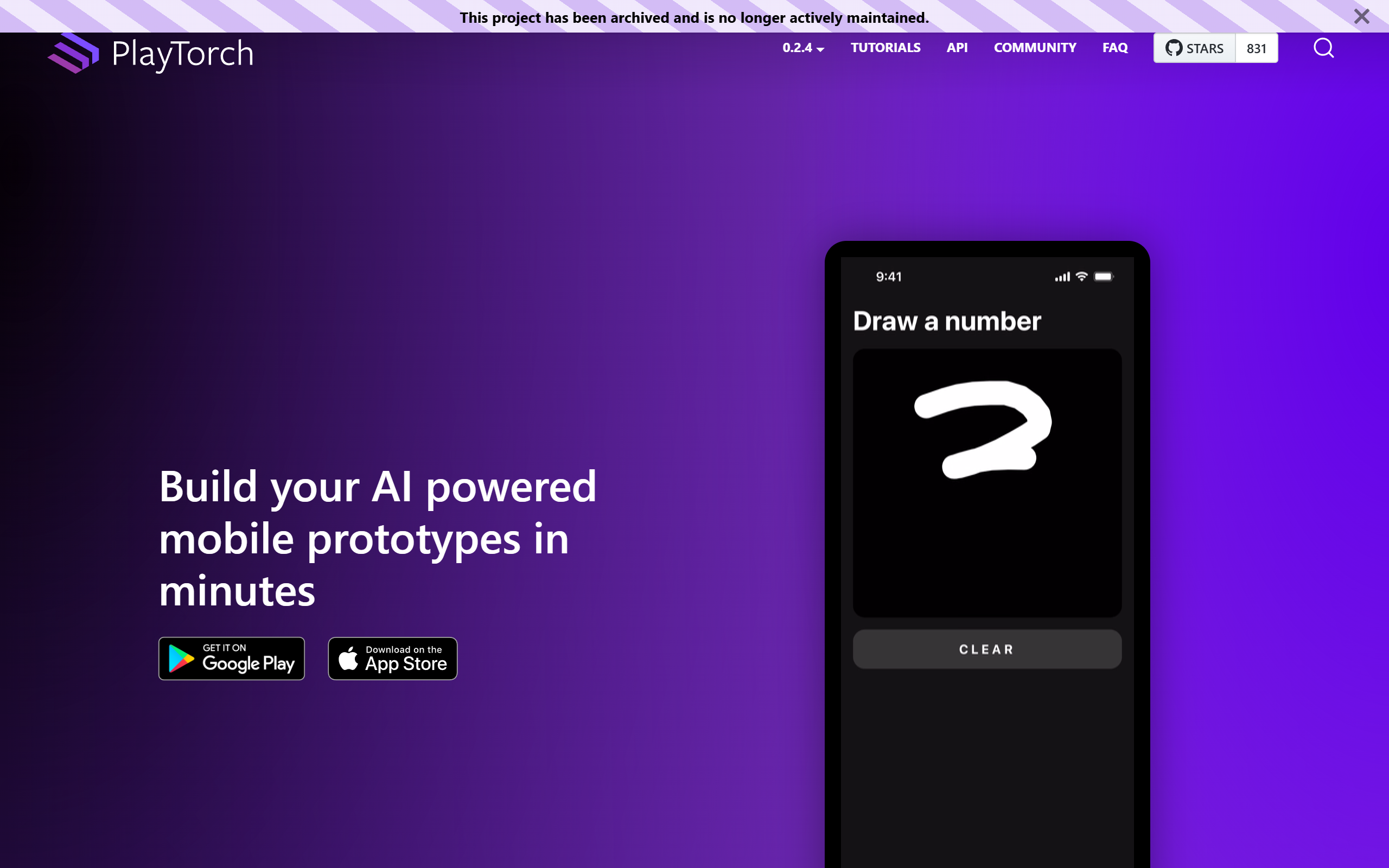
What is PlayTorch?
Key features
On-device inference
Runs PyTorch Mobile models directly on the phone for vision and language tasks, with no server round trip.
React Native SDK (torchlive)
Exposes torch, torchvision and media modules to JavaScript so models can be called from React Native code.
PlayTorch mobile app and Snacks
A companion app lets developers scan a QR code and test JavaScript snippets on a real device in minutes.
Camera and Canvas views
Built-in CameraView and CanvasView components capture frames and render results such as bounding boxes overlaid on the camera feed.
Text tokenizers
Includes BasicTokenizer and WordpieceTokenizer modules for natural language processing pipelines.
Ready-made demos
Ships examples for image classification, object detection (YOLOv5), question answering, AnimeGAN style transfer and a French translator.
Custom model preparation
Tooling to package and optimise your own PyTorch models for mobile deployment.
Pros & cons
Advantages
- It is fully free and open source under the MIT licence, with no usage fees or commercial restrictions.
- Models run entirely on-device, which keeps user data local and avoids inference server costs and latency.
- The React Native and Snack workflow lets web and mobile developers prototype AI features without deep native or PyTorch experience.
- Bundled demos for classification, detection, translation and generative models give clear, runnable starting points.
- Backed by the wider PyTorch and Meta open-source ecosystem, so the underlying runtime is well documented.
Limitations
- The project was archived by Meta in October 2023 and is no longer actively maintained, so there are no bug fixes or new features.
- Compatibility with current React Native, Expo and mobile OS versions is not guaranteed and may require manual fixes.
- It targets developers only and assumes familiarity with React Native and PyTorch model preparation.
- On-device performance is limited by phone hardware, so large models may run slowly or not at all.
Use cases
Mobile developers prototyping image classification or object detection features that run offline on the device.
Researchers and students demonstrating PyTorch models on phones without building a custom native app.
Hackathon and proof-of-concept teams wanting to test an AI idea on a real device in minutes via the PlayTorch app.
React Native engineers adding on-device language tasks such as question answering or translation to an app.
Educators teaching on-device machine learning concepts using the ready-made demo snacks.
Ready to try PlayTorch?
Pricing
Open Source (MIT)
Free
Full framework, React Native SDK, mobile app and all demos available under the MIT licence at no cost. Project is archived and community-supported.
Get started with PlayTorch
Click through to PlayTorch and start using it now.
- Open source
- Free forever