
Remalt
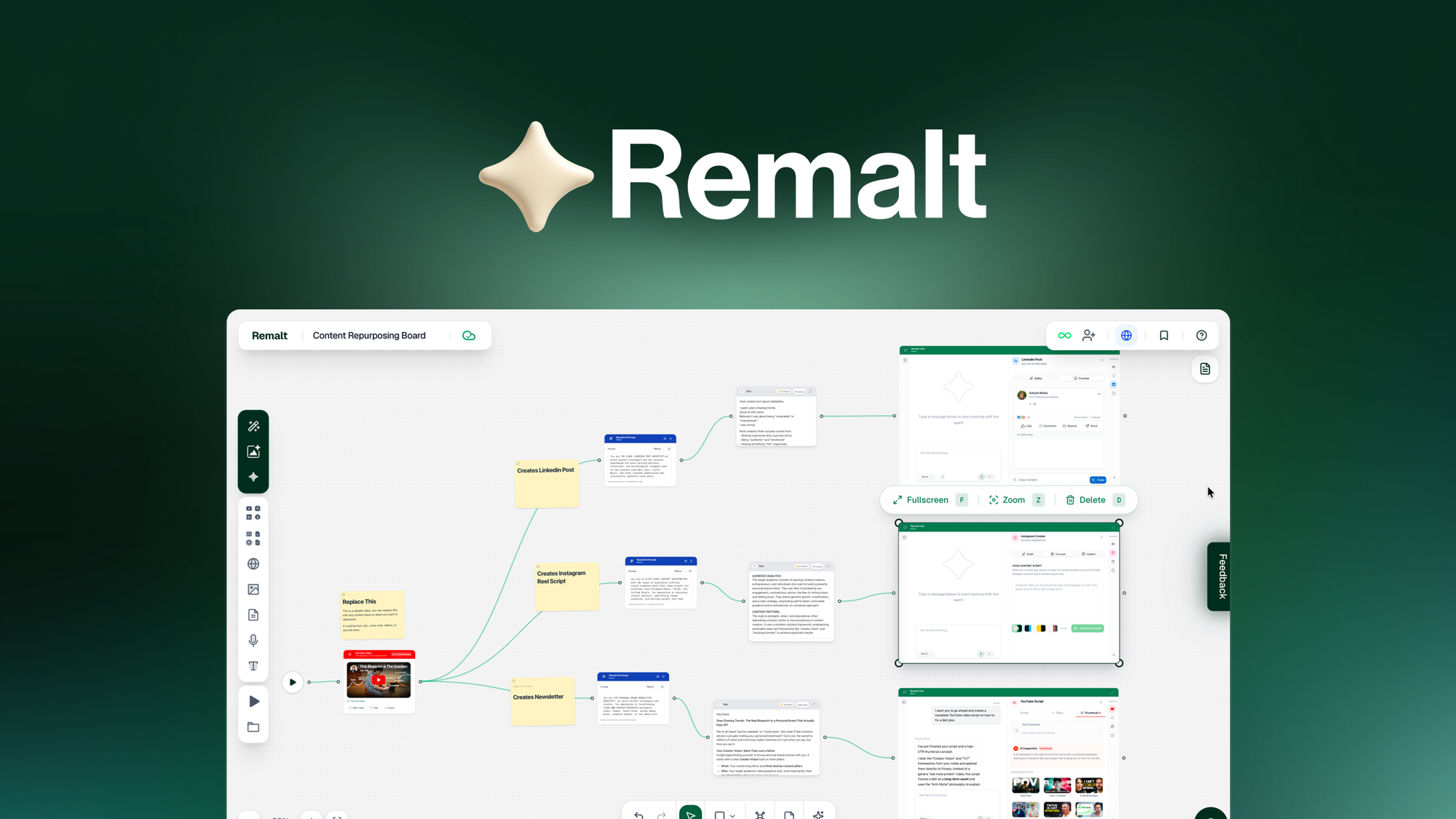
Orchestrate 9+ LLMs and custom agents to build platform-ready content on a visual brainboard
- Paid
- Web, API
- WritingDesignImage Generation
What is Remalt?
Key features
Support for 9+ language models, allowing you to select the best model for each content task
Visual brainboard interface for designing and visualising content workflows
Custom agent creation to specialise models for your specific content type or requirements
Multi-step workflow pipelines with conditional branches and dependencies
Platform-ready output formatting optimised for direct publication
Ability to save and reuse workflows for consistent content production
Pros & cons
Advantages
- Centralised workspace eliminates the need to switch between multiple AI tools
- Visual workflow design makes complex content pipelines clear and easy to modify
- Custom agents allow you to build models tuned to your specific industry or content style
- Output is formatted for your target platform, reducing manual post-processing
- Workflow reusability means you can scale content production efficiently
Limitations
- Requires paid subscription, making it a commitment for teams with limited budgets
- Visual interface requires learning before you can design complex workflows effectively
- You remain dependent on the reliability and availability of the underlying LLM APIs
- Setting up sophisticated multi-model pipelines requires time and experimentation
Use cases
Content agencies producing bulk content for multiple clients across different sectors
Marketing teams automating blog posts, email campaigns, and social media content
Product teams generating documentation, help centre articles, and release notes
E-commerce companies creating product descriptions and marketing copy at scale
Publishers and news organisations scaling article generation across multiple topics
Ready to try Remalt?
Pricing
Starter
Contact sales
Access to multiple LLMs, basic brainboard workflows, suitable for small to medium teams evaluating the platform
Pro
Contact sales
Advanced workflow builder, custom agents, higher usage limits, priority API access for production use
Enterprise
Contact sales
Unlimited workflows and usage, dedicated support, custom integrations, security and compliance features
Get started with Remalt
Click through to Remalt and start using it now.