Robovision.ai
No-code computer vision AI platform for building, deploying and governing industrial vision systems at scale.
- Paid
- Web, Cloud, On-premises, API
- Data & AnalyticsCodeEducation
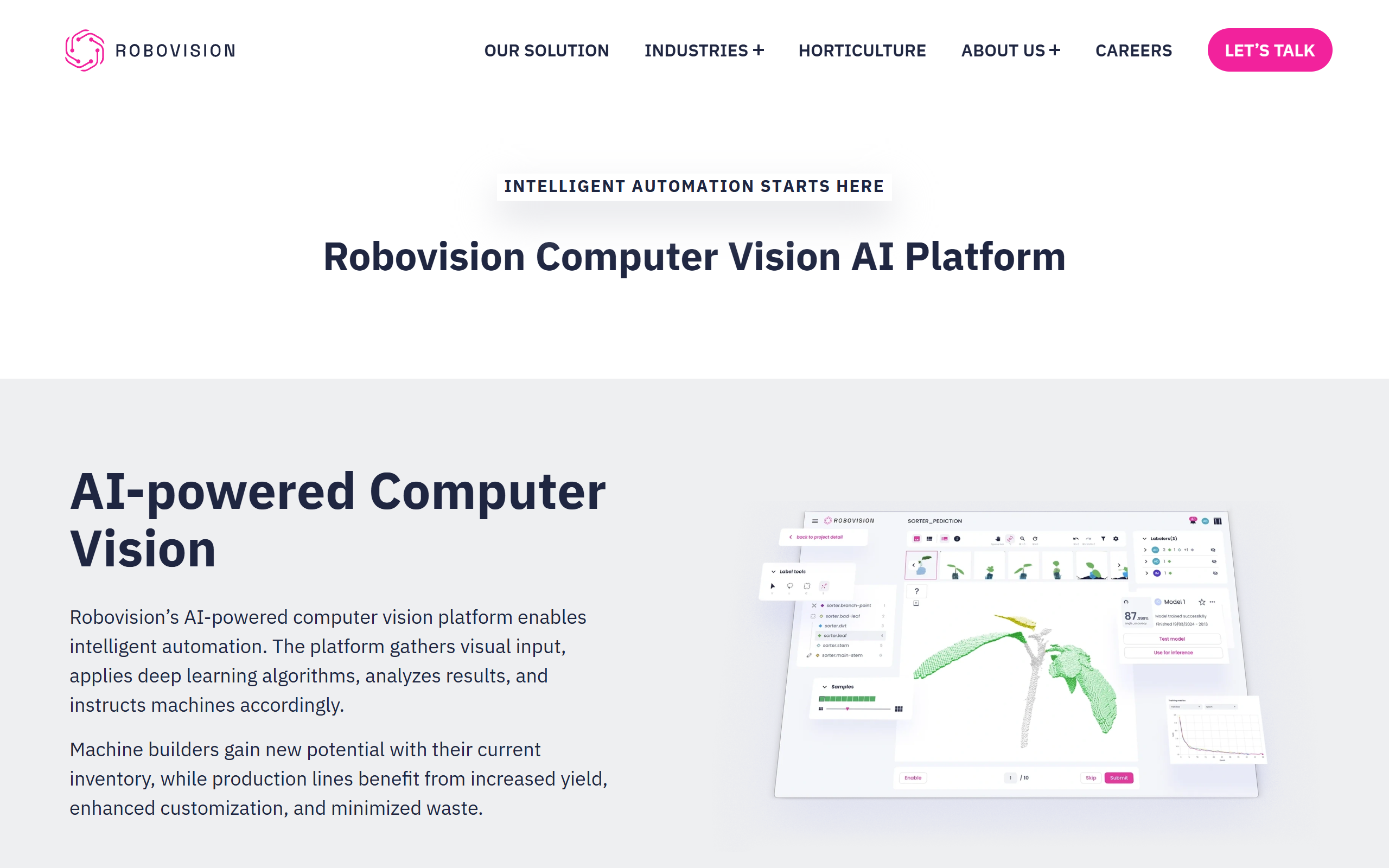
What is Robovision.ai?
Key features
Data import and annotation
Tools to import, annotate and curate visual datasets for model training.
Model training and testing
Train and validate deep learning models within the platform interface.
Model optimisation and deployment
Optimise trained models and deploy them in the cloud or on premises.
Built-in vision algorithms
Includes semantic segmentation, instance segmentation, classification, object detection, anomaly detection and multiview classification.
No-code workflow
Build and run vision applications without requiring in-house AI or coding expertise.
Lifecycle governance
Monitors and standardises vision performance across machines, sites and deployments as conditions change.
Marketplace availability
Offered through the AWS Marketplace and Microsoft Marketplace alongside direct deployment.
Pros & cons
Advantages
- The no-code approach means engineering and production teams can build vision models without specialist AI developers.
- It covers the complete model lifecycle, from data annotation through training to deployment, in a single platform.
- Deployment options include both cloud and on-premises, which suits factory and edge environments.
- A wide set of built-in algorithms covers common industrial tasks such as defect detection, classification and segmentation.
- Lifecycle governance helps keep model accuracy stable as production lines and conditions shift over time.
Limitations
- There is no public pricing, so prospective buyers must contact sales or use marketplace listings to get costs.
- The platform is aimed at industrial vision use cases and is not suited to general consumer or hobbyist projects.
- Getting started typically still requires labelled data and some understanding of the production problem being solved.
Use cases
Manufacturers automating visual quality control and defect detection on production lines.
Food, beverage and packaging companies sorting, grading or inspecting products by appearance.
Semiconductor producers running anomaly detection and inspection at high volumes.
Horticulture operations classifying or counting plants and produce with vision models.
Machine builders adding computer vision capability to existing equipment without an internal AI team.
Engineering teams that need to standardise and govern multiple vision systems across several sites.
Ready to try Robovision.ai?
Pricing
Custom
Contact for pricing
Computer vision AI platform with data annotation, model training, optimisation and cloud or on-premises deployment. No public pricing; quotes via the Robovision sales team, with usage-based options listed on the AWS and Microsoft marketplaces.
Get started with Robovision.ai
Click through to Robovision.ai and start using it now.