
Secoda
AI data intelligence platform combining cataloguing, lineage, governance and monitoring across the data stack.
- Paid
- Web, Chrome Extension, API
- Data & AnalyticsResearchProductivity
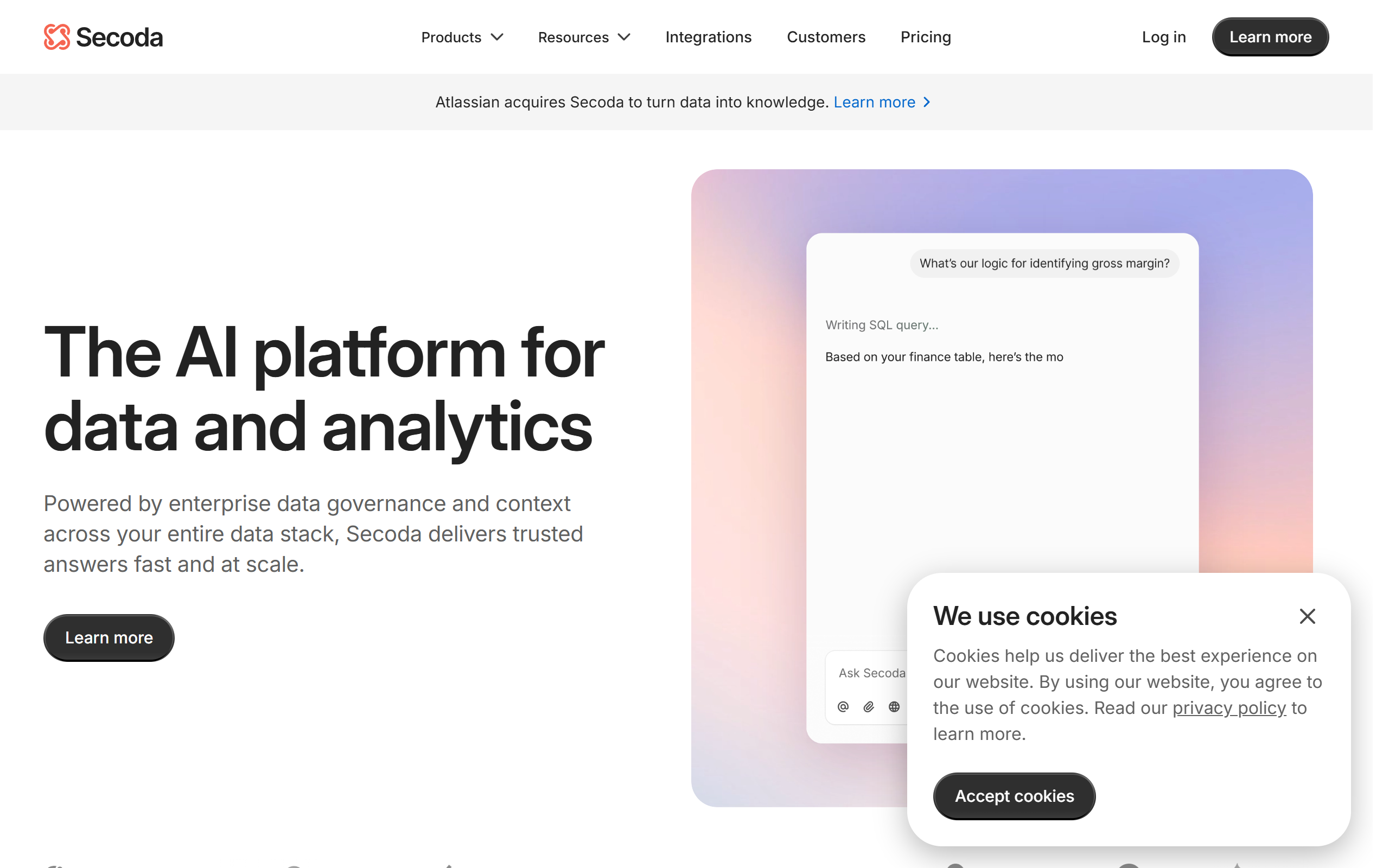
What is Secoda?
Key features
Data catalogue and search
Centralised repository of data assets with AI-assisted discovery across connected sources.
Column and table-level lineage
End-to-end visualisation of how data flows and where it originates.
Secoda AI
Natural-language search and analysis that answers questions using context from the connected stack.
Data monitoring and quality
Observability with a Data Quality Score and alerts on issues.
Governance and access control
Role-based access control, policies, PII scanning and SAML support.
Automations and API
Workflow automation, bulk metadata operations and API access for custom integrations.
Integrations
Connectors for warehouses and BI tools including Snowflake, BigQuery, Databricks, dbt, Tableau and Looker.
Pros & cons
Advantages
- Brings cataloguing, lineage, monitoring and governance into a single platform rather than separate tools.
- Secoda AI allows natural-language search across the data stack, lowering the barrier for non-technical users.
- Wide range of connectors covering common warehouses, BI and transformation tools.
- Strong security and deployment options including SAML, RBAC, single-tenant and self-hosted setups.
- Automation and API access support bulk metadata work and custom workflows.
Limitations
- No public pricing is listed, so all plans require contacting sales for a quote.
- There is no free plan and no advertised free trial on the pricing page.
- Some governance features such as policies, PII scanning and single-tenant deployment are reserved for higher tiers.
- The breadth of features may be more than smaller teams with simple data setups need.
Use cases
Data engineers use it to map column and table-level lineage and trace the impact of upstream changes.
Data analysts and business teams search and ask questions about data assets using Secoda AI.
Governance managers enforce policies, role-based access and PII scanning for compliance.
Data teams monitor quality with the Data Quality Score and act on alerts before issues spread.
Organisations centralise documentation and metadata to onboard new team members faster.
Enterprises with sensitive data deploy self-hosted or single-tenant instances with SIEM logging and custom roles.
Ready to try Secoda?
Pricing
Core
Contact for pricing
Full data catalogue, column and table-level lineage, automations, API access, workspace analytics, SAML and RBAC.
Premium
Contact for pricing
Adds Data Quality Score, policies, guest accounts, single-tenant deployment, PII scanning, VPC peering and premium support.
Enterprise
Contact for pricing
Custom roles, self-hosted deployment, access request management, SIEM logging, unlimited integrations, disaster recovery and dedicated account management.
Get started with Secoda
Click through to Secoda and start using it now.