
Solarch
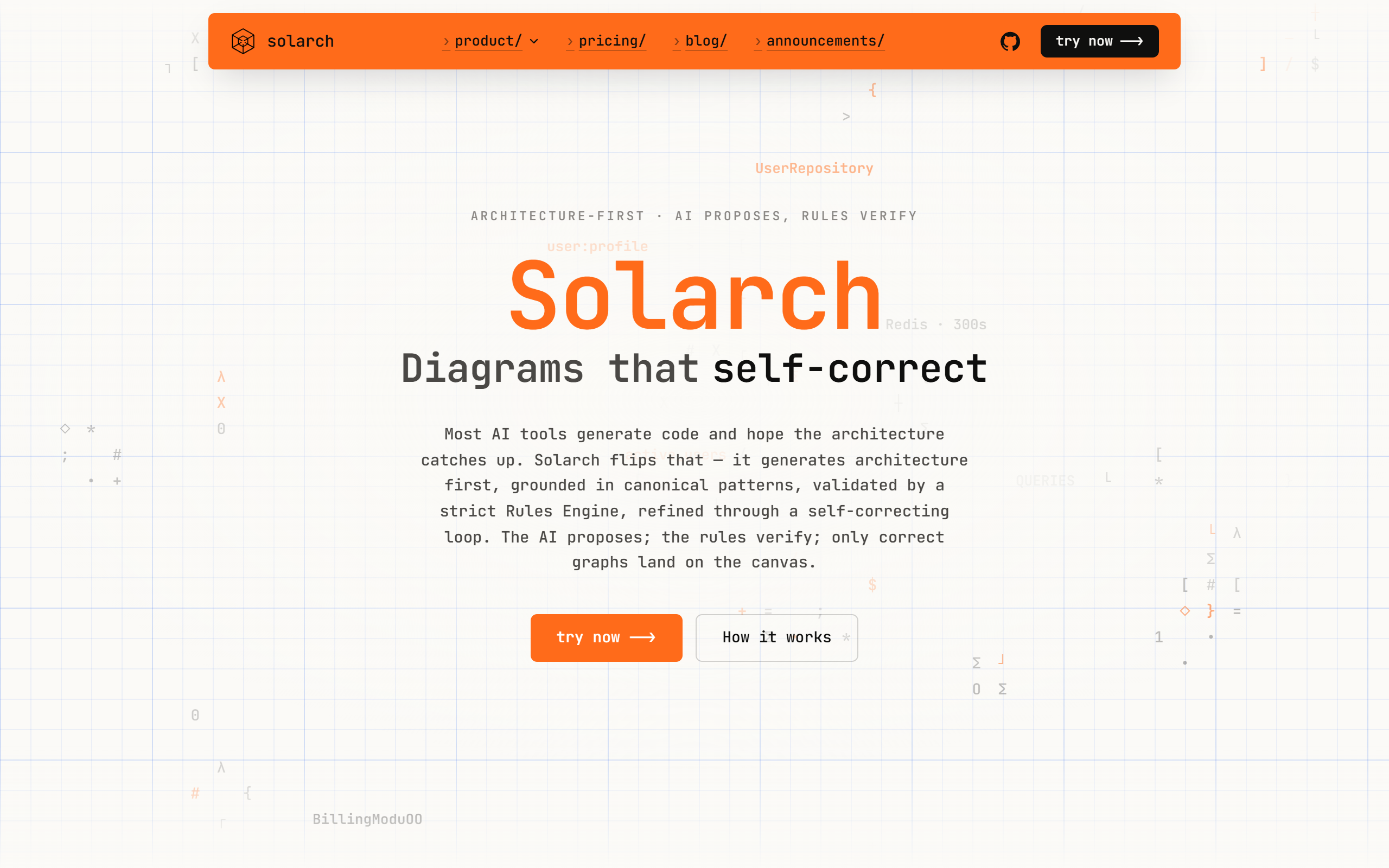
Draw your backend architecture as a node-and-edge diagram and Solarch validates it and writes the code.
- Freemium
- Web
- Code
- Free plan available
- No credit card
What is Solarch?
Key features
Live canvas
Draw backend architecture as a node-and-edge graph that maps controllers, services, repositories and databases.
Rules engine
A default-deny validation engine rejects illegal edges and architectural violations as you draw.
Code engine
Generates deterministic skeleton and boilerplate code, then uses AI to fill in the function bodies.
Typed graph model
Supports 8 node families (Data, Business, Access, Infra, Client, Security, Config, Structure) and 16 semantic edge types.
Fractal graph
Semantic zoom lets you move between macro module views and micro-level sub-graphs of the same system.
Vector export
Turns the architecture into AI-readable memory, with Mermaid diagrams and Cursor and Claude ready output.
Autonomous QA
Includes red-team testing, smart data seeding and time-travel snapshots of project state.
Pros & cons
Advantages
- The default-deny rules engine catches architectural violations at design time rather than after code is written.
- Generated code follows a deterministic skeleton, so AI is constrained to filling bodies rather than inventing structure.
- A free tier and low entry plans make it accessible for solo developers to try before committing.
- Export to Mermaid and AI-readable formats fits existing tools such as Cursor and Claude.
- The fractal zoom model lets you reason about a system at both macro and micro levels in one place.
Limitations
- The product is focused on backend architecture, so it will not suit front-end or non-software design work.
- Higher AI generation limits sit behind the more expensive Build and Code tiers, which charge per operation.
- The node-and-edge modelling approach with typed families and edges carries a learning curve.
- Public documentation of the supported output languages and frameworks is limited on the marketing site.
Use cases
Backend developers designing microservices who want the structure validated before any code is generated.
Teams that want to prevent architectural drift by enforcing rules on how components may connect.
Engineers who prefer to sketch a system visually and have boilerplate and contracts generated automatically.
Developers using AI coding assistants who want an architecture exported as AI-readable memory for Cursor or Claude.
Solo builders prototyping a backend who want deterministic skeleton code plus AI-filled function bodies.
Teams running QA who want red-team testing, seeded data and snapshot rollbacks tied to the architecture graph.
Ready to try Solarch?
Pricing
Get started with Solarch
Click through to Solarch and start using it now.
- Free plan available
- No credit card