
Stable Video Diffusion
Stability AI's open-source image-to-video generation model Pricing: Open Source. See pros, cons, alternatives, and comparisons.
- Open Source
- Web, API, Command line, Local deployment (Windows, macOS, Linux)
- VideoWritingImage Generation
- Open source
- Free forever
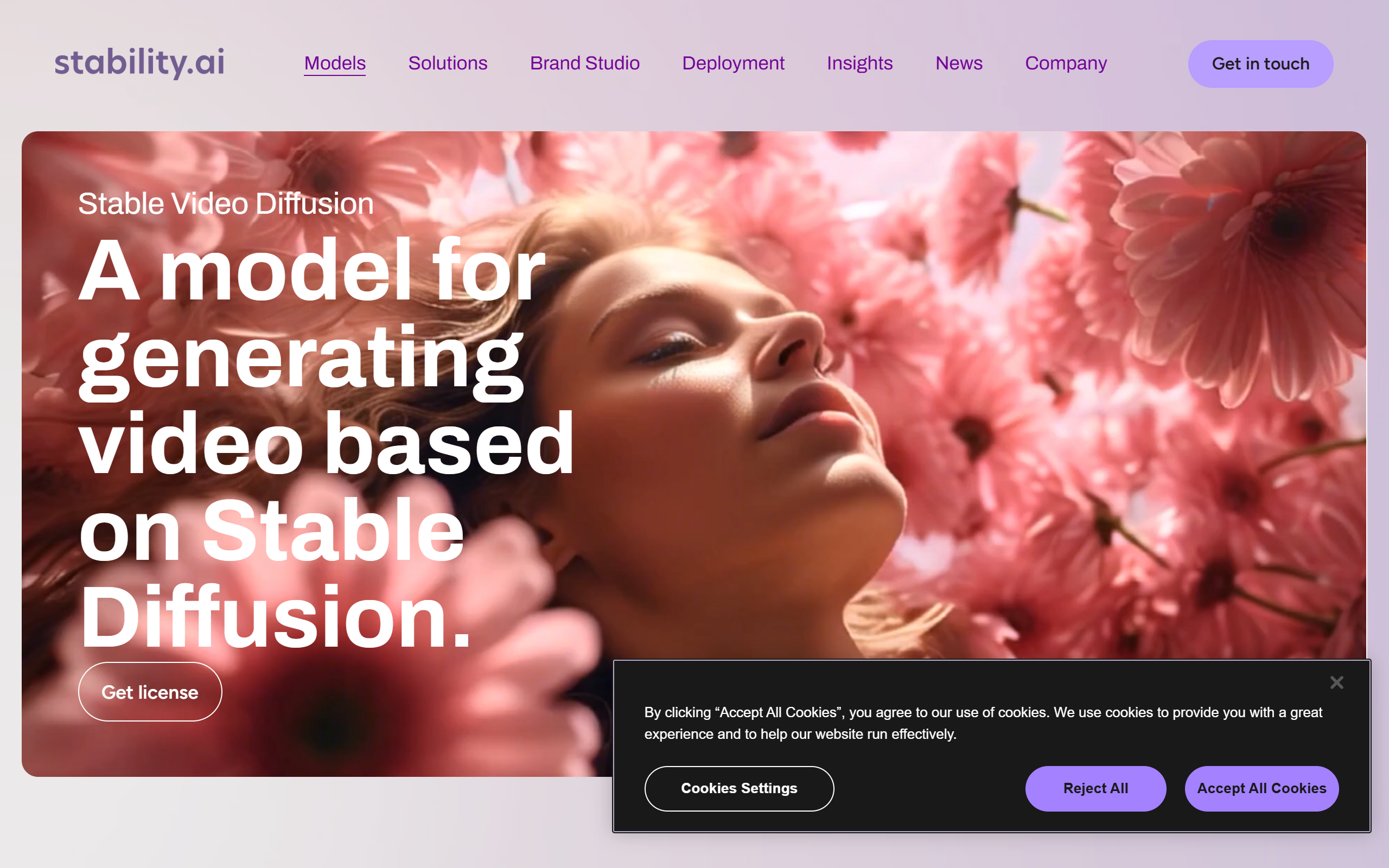
What is Stable Video Diffusion?
Key features
Image-to-video generation
converts a static image into short video sequences with realistic motion
Open-source codebase
available for local deployment, modification, and commercial use
Multiple inference options
run via API, command line, or integrate into custom applications
Customisable motion parameters
adjust motion intensity and video length within supported ranges
Community models and checkpoints
access to variations and community-trained versions
Pros & cons
Advantages
- Free to use with no API costs or subscription fees
- Can be run entirely on your own hardware for privacy and control
- Open-source design allows customisation and fine-tuning for specific needs
- Active community support with documentation and example implementations
Limitations
- Requires technical knowledge to set up and run locally, especially for GPU acceleration
- Video outputs are typically short (2-4 seconds) and work best with simple scenes
- Quality depends heavily on input image quality and motion coherence; complex scenes may produce artifacts
Use cases
Product demonstrations: animating product images for e-commerce listings
Marketing content: creating simple motion graphics from static artwork
Research and experimentation: testing video generation techniques without API costs
Game development: generating placeholder animations or background elements
Creative projects: producing stylised motion sequences for art installations or presentations
Ready to try Stable Video Diffusion?
Pricing
Open Source
Free
Full access to model code, weights, and documentation; can run locally on your own infrastructure
Get started with Stable Video Diffusion
Click through to Stable Video Diffusion and start using it now.
- Open source
- Free forever