
Tinq.ai
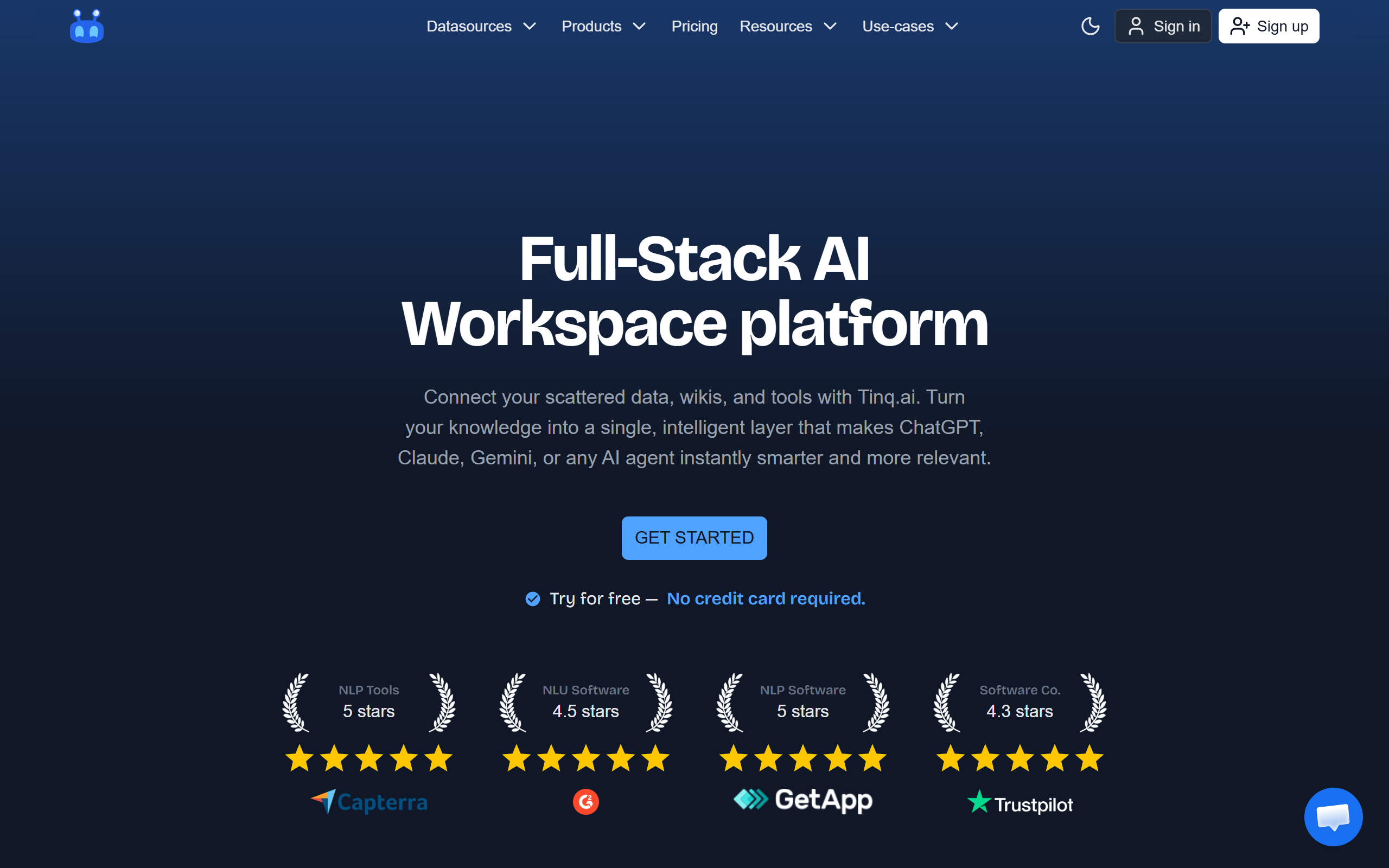
Unify your organisation's knowledge into a single AI-ready layer so ChatGPT, Claude, Gemini or any agent answers with real context.
- Freemium
- Web, API, MCP Server
- DesignDeveloper ToolsCode
- Free plan available
- No credit card
What is Tinq.ai?
Key features
Multi-source datasources
Connects Google Drive, SharePoint, Notion, Confluence, Zendesk, Jira, Salesforce and databases into one index.
Real-time sync
Re-indexes content automatically as source files and records change.
Permission mirroring
Reflects existing access controls and indexes read-only by default to protect data.
OCR indexing
Extracts and indexes text from documents, PDFs, slides and images.
OpenAI-compatible API
Plugs the unified context into any leading model or internal AI copilot.
MCP server
Exposes the knowledge layer to AI agents through the Model Context Protocol.
Citation tracking and analytics
Returns sourced answers and a dashboard tracking usage, queries and knowledge gaps.
Pros & cons
Advantages
- Pulls together data from many common business tools into a single searchable context layer.
- Indexing respects existing permissions and stays read-only by default, reducing data exposure risk.
- An OpenAI-compatible API and MCP server make it straightforward to wire into existing AI models and agents.
- Answers include citations so responses can be traced back to source documents.
- Entry pricing starts at 15 dollars per month with a free, no-card trial to test the platform.
Limitations
- Plan limits are defined by many granular quotas (tokens, conversations, datasources, retrievals) that can be hard to map to real usage.
- The cheapest paid plan is single user and caps datasources at two, so small teams will need to move up quickly.
- Free trial limits and duration are not clearly stated on the pricing page.
- Value depends on the quality and freshness of the connected sources, so poorly maintained data will limit answer accuracy.
Use cases
Support teams give an AI copilot grounded answers drawn from help-desk tickets and documentation.
New employees onboard faster by querying company wikis, drives and policies through a single assistant.
Internal knowledge management lets staff find authoritative answers across Notion, Confluence and SharePoint.
Developers add company context to their own AI agents via the OpenAI-compatible API and MCP server.
Operations teams surface knowledge gaps using the analytics dashboard that tracks queries and usage.
Ready to try Tinq.ai?
Pricing
Personal
15 per month
1 user, 100 conversations, 10 documents, 500K tokens, 2 datasources, 3 workspaces and 3-day log retention. Free, no-card trial available.
Spark
55 per month
Up to 10 users, 500 conversations, 50 documents, 1M tokens, 10 datasources, 1 vector store, 5 workspaces and 30-day log retention. Recommended plan.
Growth
150 per month
Up to 25 users, 1,000 conversations, 500 documents, 5M tokens, 20 datasources, 1 vector store, 25 workspaces and 90-day log retention.
Get started with Tinq.ai
Click through to Tinq.ai and start using it now.
- Free plan available
- No credit card