Trapica
Enterprise AI platform that automates campaign optimisation, bidding and audience targeting across 20+ ad channels.
- Paid
- Web, API
- Data & AnalyticsDeveloper ToolsMarketing
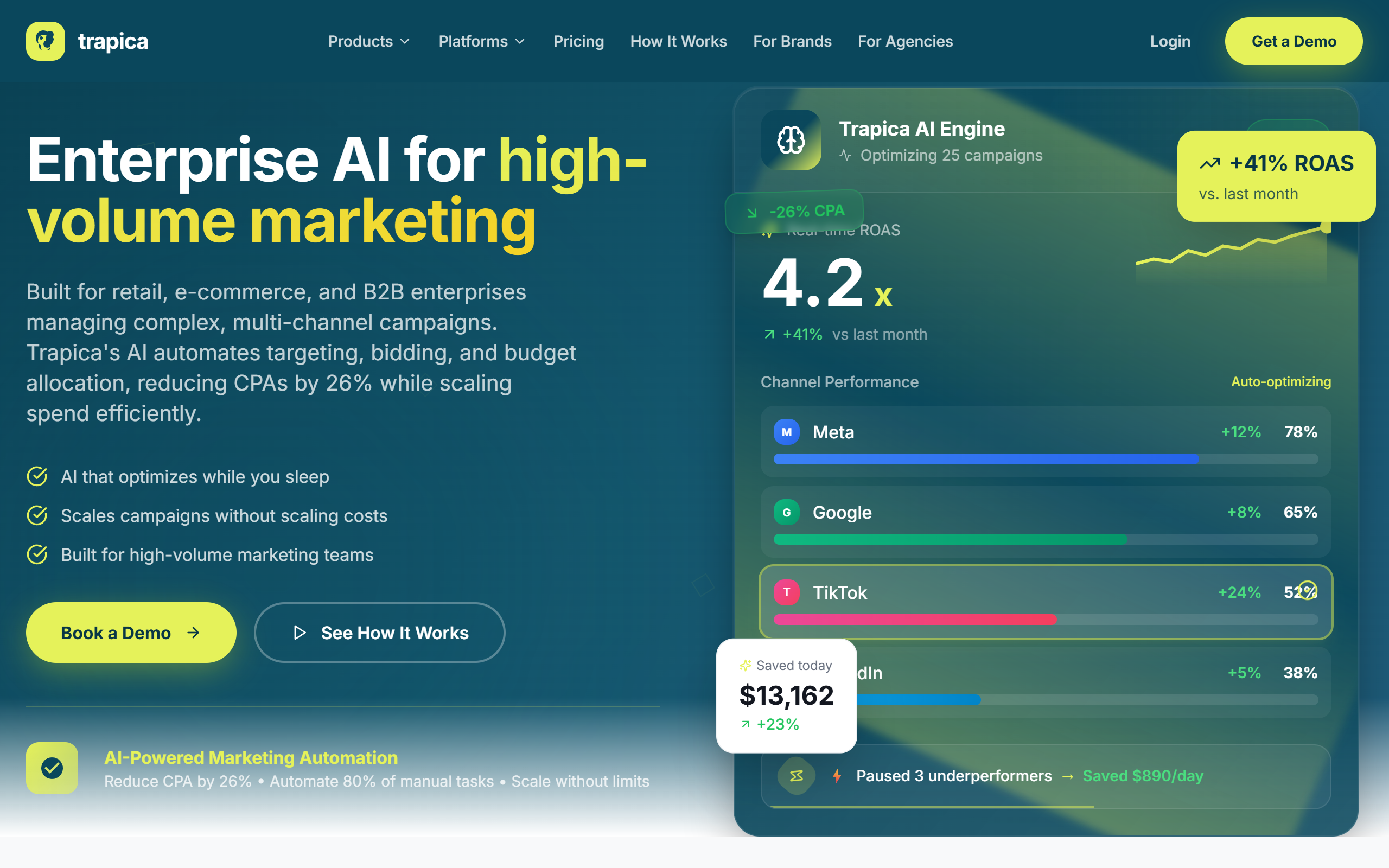
What is Trapica?
Key features
AI bid optimisation
Automatically adjusts bids and budget distribution across connected ad accounts in real time.
Audience targeting and discovery
Uses behavioural analysis and intent prediction to find and refine target audiences.
Cross-channel management
Coordinates and optimises campaigns across Meta, Google, TikTok, LinkedIn and 20+ other platforms from one place.
Automated A/B testing
Runs experiments and applies winning variations without manual intervention.
Decision Pro insights
Turns performance data into strategic recommendations and scenario planning.
Predictive analytics
Models expected campaign performance and surfaces optimisation opportunities.
Anomaly detection and alerts
Tracks KPIs in real time and flags performance anomalies as they happen.
Pros & cons
Advantages
- Connects to a wide range of ad platforms, including Meta, Google, TikTok, LinkedIn, Amazon Ads and Microsoft Ads, so multi-channel campaigns can be managed in one tool.
- Automation reduces the need for manual weekly bid and budget reviews by running adjustments continuously.
- One-click OAuth integration and a no-code setup let marketing teams operate without engineering support.
- Tiered plans (Automation, Intelligence, Enterprise) allow the platform to scale from single-platform users to large multi-market teams.
- Enterprise tier adds custom AI model training, dedicated success management and SLA guarantees for larger accounts.
Limitations
- No pricing is published on the website, so every plan requires contacting sales or booking a demo to get a quote.
- Performance claims such as 26% CPA reduction and 41% ROAS improvement are vendor figures presented without independent verification.
- Multi-platform support, API access and priority support are reserved for the higher Intelligence and Enterprise tiers rather than the entry plan.
- The platform is positioned for high-volume advertisers, which may make it a poor fit for very small budgets or single low-spend campaigns.
Use cases
E-commerce brands optimising bids and budgets across large multi-product catalogues on several ad networks.
Performance marketing teams automating bid and budget management to cut manual optimisation work.
Agencies managing many client ad accounts across multiple platforms from a single dashboard.
Lead generation teams aiming to lower cost per acquisition while maintaining lead quality.
Mobile app marketers optimising installs and in-app actions across ad channels.
Enterprise marketing teams running complex multi-market campaigns that need custom attribution and integrations.
Ready to try Trapica?
Pricing
Automation
Contact for pricing
AI campaign optimisation, AI bid management, AI-powered targeting and audience discovery, real-time KPI tracking and alerts, AI Decision Pro insights, anomaly detection, A/B test automation, single platform support.
Intelligence
Contact for pricing
Everything in Automation plus cross-channel budget optimisation, advanced audience intelligence, competitor analysis and benchmarks, predictive performance modelling, custom KPI dashboards, multi-platform support, priority support and API access. Marked as most popular.
Enterprise
Contact for pricing
Everything in Intelligence plus unlimited platforms and campaigns, dedicated success manager, custom AI model training, advanced attribution modelling, white-glove onboarding, custom integrations and webhooks, and SLA guarantees.
Get started with Trapica
Click through to Trapica and start using it now.