Wolfram Alpha
Computational knowledge engine for STEM Pricing: Freemium. See pros, cons, alternatives, and comparisons.
- Freemium
- Web, iOS, Android, API, Wolfram Language integration
- WritingAI Tools for MathematicsResearch
- Free plan available
- No credit card
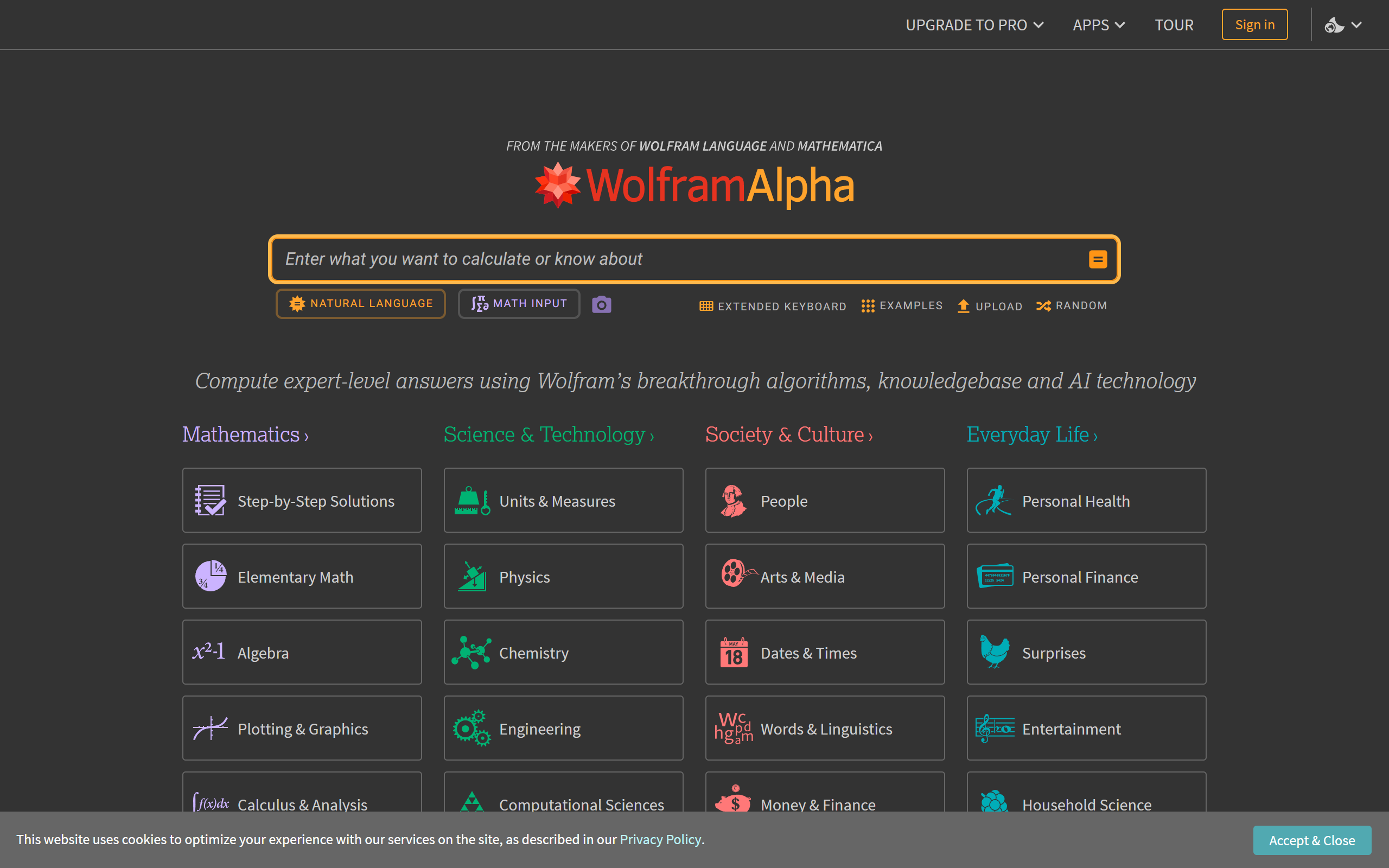
What is Wolfram Alpha?
Key features
Natural language query processing
ask questions in plain English and receive computed answers
Step-by-step solutions
view the working behind mathematical and scientific calculations
Data visualisation
graphs, plots, and charts to display relationships and patterns
Unit conversion and scientific constants
quick access to conversions and reference values
Wolfram Language integration
access to the underlying Wolfram Language for advanced computation
Chemical and molecular analysis
structure visualisation and property information for compounds
Pros & cons
Advantages
- Provides actual answers and computations rather than links to webpages
- Shows working for calculations, helping you understand the method
- Handles complex queries across multiple domains without requiring you to phrase them precisely
- Free tier is genuinely useful for students and casual users
Limitations
- Free tier has query limits and restricted access to some features; paid subscription required for frequent heavy use
- Results quality varies depending on how clearly you phrase your question; ambiguous queries may return unhelpful output
- Less effective for subjective questions or topics requiring interpretation rather than computation
Use cases
Students checking working on maths and physics homework problems
Engineers and scientists verifying calculations and exploring theoretical scenarios
Data analysis and statistical queries on publicly available datasets
Quick reference for unit conversions, chemical properties, and physical constants
Exploring mathematical concepts through visualisation and computed examples
Ready to try Wolfram Alpha?
Pricing
Get started with Wolfram Alpha
Click through to Wolfram Alpha and start using it now.
- Free plan available
- No credit card