
Xapian
Build powerful, customizable databases and optimize search speed and scalability.
- Freemium
- API, Web
- Data & AnalyticsDesignResearch
- Free plan available
- No credit card
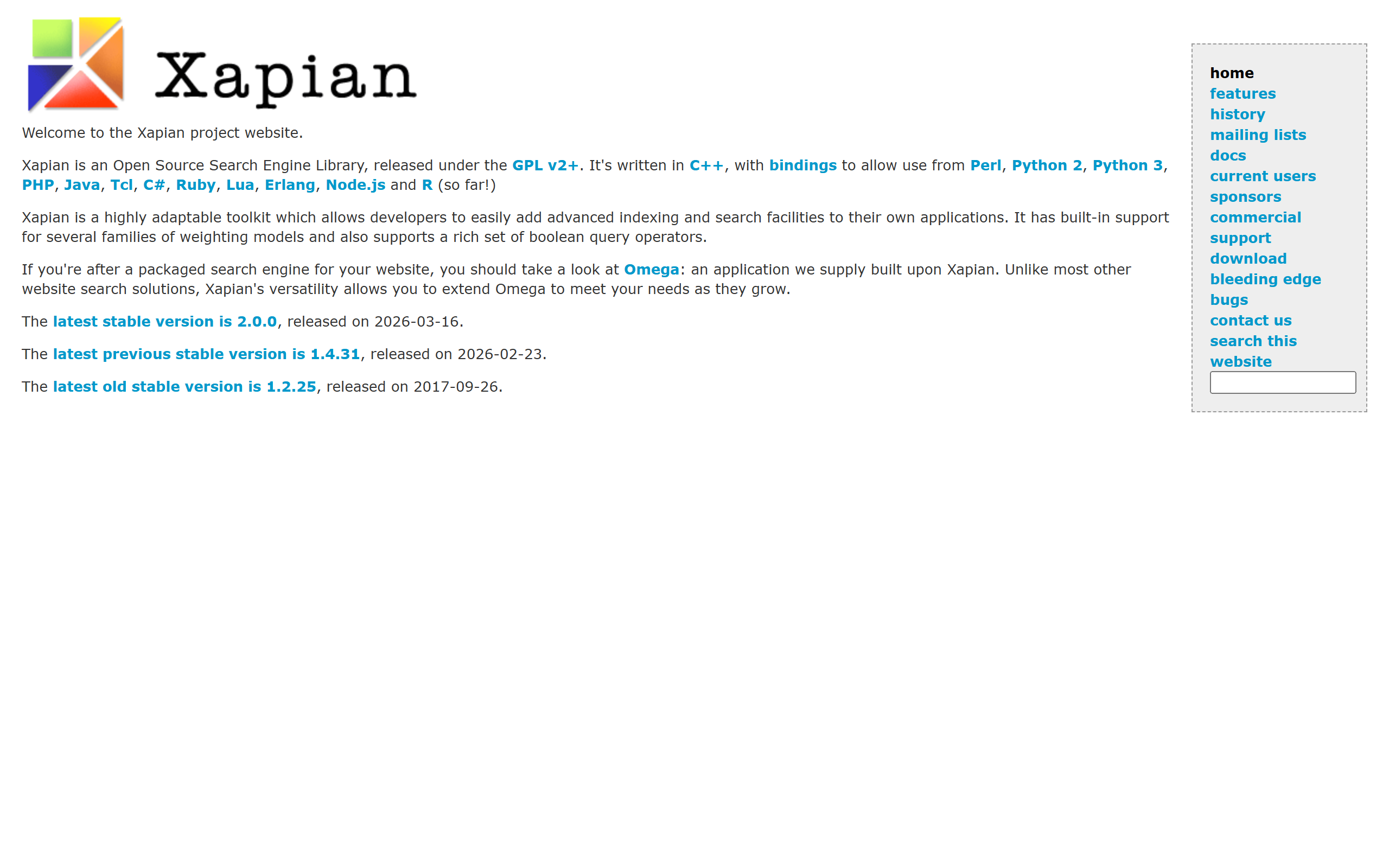
What is Xapian?
Key features
Full-text search
Index and search large document collections with support for multiple languages and stemming algorithms
Faceted search
Allow users to filter results by categories, dates, price ranges, and other custom fields
Ranking and relevance
Customisable ranking algorithms to control how results are ordered based on relevance, popularity, or other factors
Scalable indexing
Handle millions of documents whilst maintaining reasonable query speeds
Multiple language support
Built-in support for stemming and language-specific text processing across many languages
API bindings
Available for C++, Python, PHP, Java, Ruby, Perl, and other languages, making integration straightforward
Pros & cons
Advantages
- Free and open-source, with no licensing costs or vendor lock-in
- Performs well on large datasets without requiring expensive hardware or cloud infrastructure
- Highly customisable; you control indexing strategies, ranking algorithms, and search behaviour
- Mature and stable codebase with a long track record of production use
- Lightweight footprint makes it suitable for embedded systems and resource-constrained environments
Limitations
- Requires technical expertise to implement; it's a library, not a ready-made search service
- You're responsible for managing the index, backups, and maintenance yourself
- Smaller community compared to commercial search platforms, so fewer pre-built extensions and integrations
Use cases
Building search functionality into document management systems or knowledge bases
Adding product search to e-commerce platforms with custom filtering and sorting
Creating search interfaces for large archives or historical records
Implementing local search in desktop or mobile applications without relying on external services
Building specialised search engines for specific industries or domains
Ready to try Xapian?
Pricing
Free
Free
Complete access to the open-source library, all core search functionality, and community support
Get started with Xapian
Click through to Xapian and start using it now.
- Free plan available
- No credit card