ZeroGPU
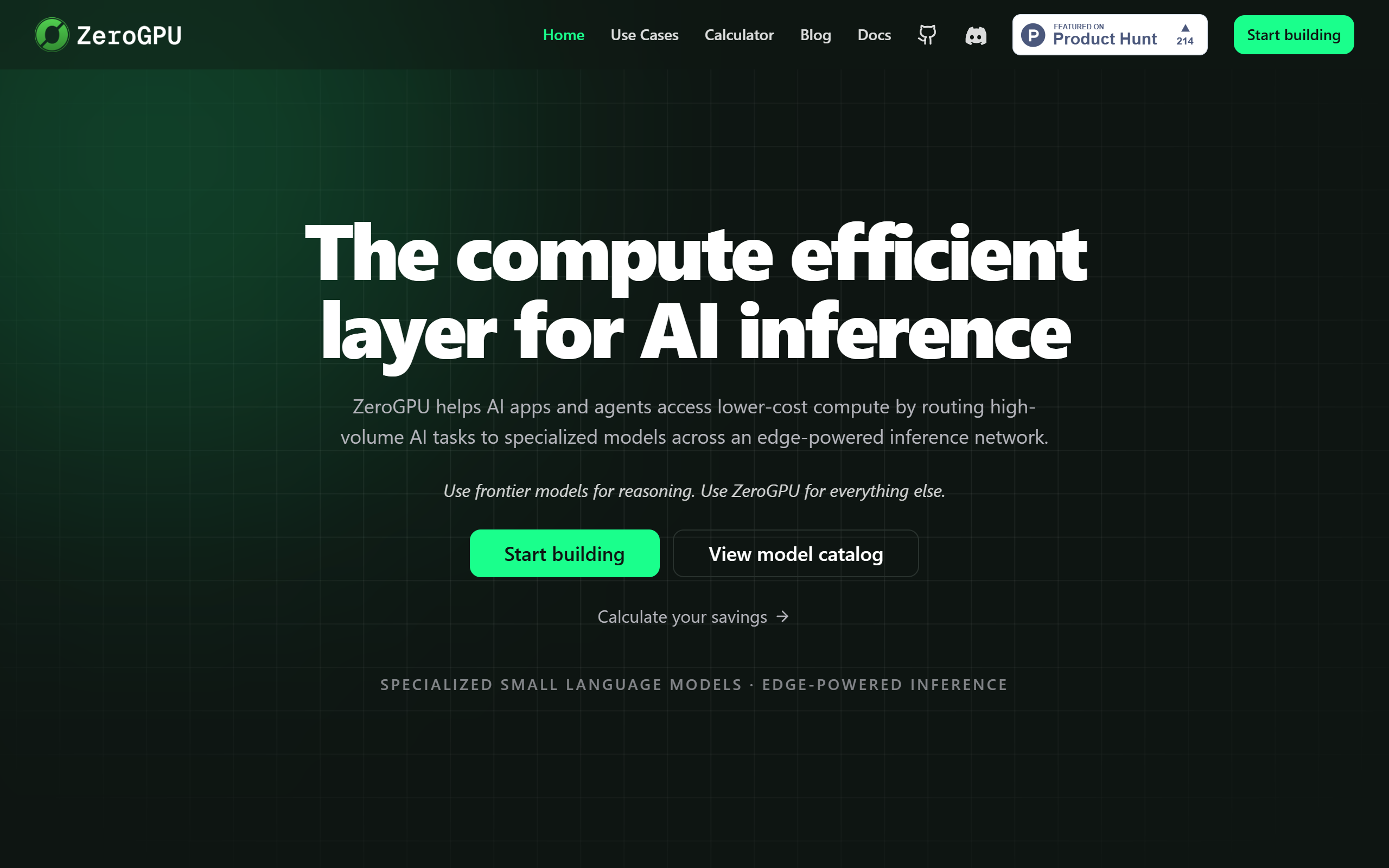
The compute efficient layer for AI inference, routing high-volume tasks to small and nano models to cut cost and latency.
- Paid
- Web, API
- Other
What is ZeroGPU?
Key features
OpenAI-compatible API
Drop-in chat and responses endpoints that work with existing OpenAI client code.
Small and nano model routing
Routes routine tasks to specialised small language models instead of frontier models.
Edge-powered inference
Distributed inference across an edge network with cloud fallback for scale and lower latency.
Cost calculator
An interactive tool to estimate spend and compare ZeroGPU model rates against providers such as GPT-5.4.
Project-level API keys
Per-project keys with usage analytics for tracking consumption.
Task-specific workloads
Built for classification, extraction, summarisation, PII detection, fraud detection, content moderation and query routing.
Monetize Your App SDK
An SDK that lets app developers earn revenue by having their users' idle devices fulfil network inference jobs.
Pros & cons
Advantages
- The OpenAI-compatible API means existing applications can switch with minimal code changes.
- Per-token rates are very low for supported small models, with a claimed cost reduction of more than 50 percent on routine workloads.
- It covers a wide range of practical use cases including moderation, fraud detection, translation and document processing.
- The interactive calculator gives transparent per-million-token rates and side-by-side cost comparisons before committing.
- Usage-based billing means there is no fixed subscription, so spend scales with actual volume.
Limitations
- There is no dedicated pricing page, so full rate cards across all models are not published and must be gathered from the calculator.
- The model catalogue is geared towards smaller models, so it is not a substitute for top-tier frontier reasoning models.
- No free tier or sign-up credits are advertised on the public pages, so evaluation cost is unclear up front.
- Documentation lives on a separate docs subdomain and some linked pages were not reachable during review.
Use cases
AdTech teams classifying user intent and mapping IAB categories in real time for ad targeting.
Trust and safety teams moderating millions of posts with toxicity detection, NSFW filtering and policy checks.
Compliance and security teams redacting PII and detecting prompt injection or jailbreak attempts at scale.
Fintech teams running fraud detection, transaction risk scoring and trading sentiment analysis.
Document-heavy businesses extracting structured data from invoices, contracts and forms via OCR.
AI agent developers using small models for tool selection, query routing and multi-step reasoning cheaply.
Ready to try ZeroGPU?
Pricing
Usage-based
From $0.02 in / $0.05 out per 1M tokens (llama-3.1-8b-instruct-fast)
Pay-as-you-go per-token billing, OpenAI-compatible API, project-level API keys and usage analytics. Rates vary by model; use the cost calculator to estimate spend.
Get started with ZeroGPU
Click through to ZeroGPU and start using it now.